
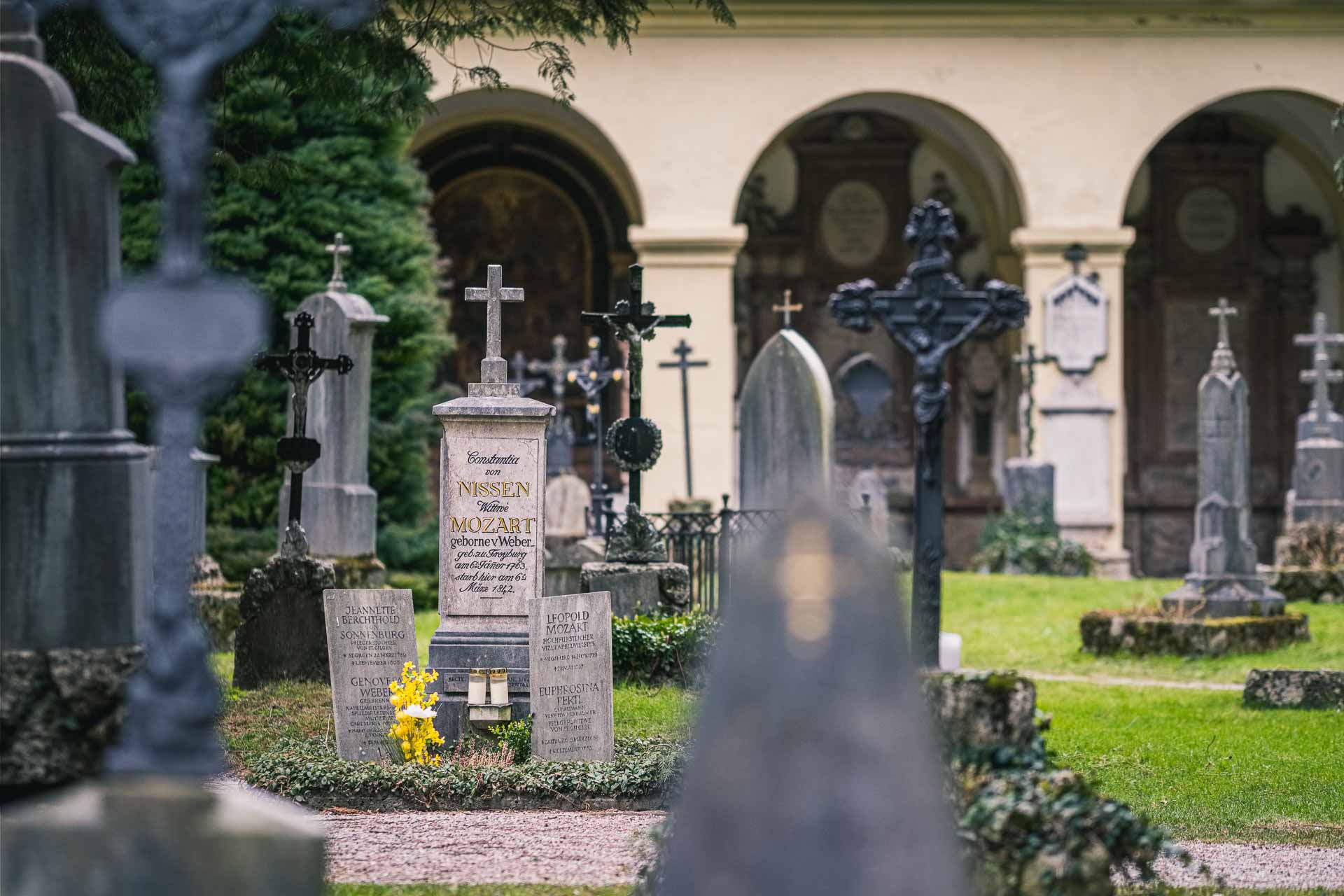
St. Sebastian’s Cemetery is easy to miss, even if you spend several days in Salzburg.
It sits just off Linzer Gasse, on the right bank of the Salzach river, outside the usual sightseeing loop. Most visitors never pass it by accident. You don’t stumble into it on the way from the cathedral to Getreidegasse, and it’s not next to any of the city’s big postcard sights.
From the Spirit of Mozart statue near Staatsbrücke, where the Free Walking Tour meeting point is located, it’s about a ten-minute walk uphill along Linzer Gasse. That walk is practical but unspectacular. There’s no visual build-up, no landmark pulling you forward, no hint that something worth stopping for is waiting at the end.
That’s part of why the cemetery stays quiet.
Behind a plain church façade and an iron gate that doesn’t try to attract attention, the city changes pace almost instantly. Traffic noise drops. Footsteps soften. Even on busy days, the space feels contained and calm.
This is why I like St. Sebastian’s Cemetery. Not because it’s dramatic or famous, but because it offers a consistently peaceful pause in an otherwise busy city. Salzburg doesn’t have many places like this that are both central and genuinely quiet.
Once inside, the cemetery doesn’t ask you to move quickly or look at anything in a specific order. It’s small, enclosed, and easy to take in at your own speed. You can spend ten minutes here or forty, and both feel reasonable.
It’s not a hidden gem in the marketing sense. It’s simply overlooked. And that’s exactly what allows it to work.
An Italian-Style Cemetery in an Alpine City
St. Sebastian’s Cemetery was created at the end of the 16th century, during a period when Salzburg was ruled by powerful prince-archbishops who controlled both religious and political life.
Instead of expanding a traditional burial ground, the decision was made to build an enclosed cemetery inspired by Italian campo santo courtyards. This was unusual for the region north of the Alps.
The result is a rectangular courtyard surrounded by arcades on all four sides. Graves are placed into the walls rather than spread across the ground. Tombstones lean inward, facing the center. The space feels ordered and deliberate.
The design limits visual distraction. There are no long sightlines, no dominant monument competing for attention. Everything stays at human scale.
This architectural choice is a big reason why the cemetery feels calm rather than heavy.
Prince-Archbishop Wolf Dietrich and the Purpose of the Site
The cemetery was commissioned under Prince-Archbishop Wolf Dietrich von Raitenau, one of Salzburg’s most influential early Baroque rulers.
Wolf Dietrich is better known for reshaping the city’s architecture and power structure, but St. Sebastian’s Cemetery reflects a different side of his rule. It was not built to impress visitors or project authority. It was built to give death a structured, contained place within the city.
This mattered at a time when disease outbreaks were common and fear of epidemics shaped urban planning.
The cemetery replaced an earlier plague burial ground that had been located further outside the city walls. Bringing burial closer to the city, but in a controlled and enclosed form, balanced practical needs with spiritual concerns.
Why the Cemetery Is Dedicated to Saint Sebastian
The cemetery and the adjacent church are dedicated to Saint Sebastian, a figure closely associated with protection against plague and disease.
In early modern Europe, Saint Sebastian’s imagery served a very specific purpose. His martyrdom, shown pierced by arrows, symbolized endurance through suffering and protection against invisible threats like illness.
This was not abstract symbolism. It was reassurance.
People buried here, and those visiting them, understood Saint Sebastian as a guardian figure during a time when medical knowledge was limited and outbreaks could devastate entire communities.
The dedication reflects how closely fear, faith, and daily life were connected in Salzburg at the time.
The Gabriel Chapel at the Center of the Cemetery
At the center of the courtyard stands the Gabriel Chapel, easily recognized by its patterned dome and compact proportions.
The chapel was built as a family mausoleum connected to Wolf Dietrich’s lineage. His father is buried here.
Architecturally, the chapel anchors the entire cemetery. The arcades, graves, and pathways all orient around it. Without the chapel, the space would feel incomplete.
From the outside, it appears restrained and balanced. When the interior is accessible, it reveals frescoes and tombs that emphasize acceptance rather than fear.
Even when closed, the chapel defines the atmosphere of the cemetery. It prevents the space from feeling random or fragmented.
Mozart’s Family and What the Graves Really Mean
Many visitors associate St. Sebastian’s Cemetery with Mozart, but it helps to understand the facts clearly.
Wolfgang Amadeus Mozart himself is not buried here. He died and was buried in Vienna.
What you will find instead are graves associated with members of his family:
Leopold Mozart, his father, is commemorated here.
Constanze Mozart, his widow, is buried here alongside her second husband.
Other relatives are linked to the site through memorial markers.
An important detail often left out is that several of these graves are symbolic rather than guaranteed burial locations.
Over the centuries, graves were reused, relocated, or removed when family maintenance fees expired. Modern research, including DNA testing connected to Mozart-related investigations, showed that some remains traditionally attributed to certain individuals were not genetically related.
This does not reduce the site’s significance. It highlights how memory and commemoration worked historically in Salzburg.
If you want to explore Mozart’s family story further, St. Peter’s Cemetery is a useful comparison, as it contains other family graves, including that of Mozart’s sister, Nannerl.
The Grave of Paracelsus
Just inside the entrance passage, you’ll find one of the cemetery’s most unusual graves: that of Paracelsus.
Paracelsus was a Renaissance physician, alchemist, and philosopher who rejected much of medieval medical theory. He believed in observation, experimentation, and treating patients based on experience rather than authority.
He died in Salzburg in 1541 and was buried here. His tomb became a place of interest very quickly. By the early 17th century, travelers already sought it out.
What makes his burial here striking is the contrast. A man who challenged academic and religious authority rests inside an archbishop’s cemetery.
His will left his possessions to the poor of Salzburg, and his reputation as a radical thinker persisted long after his death.
This is one of the most intellectually interesting graves in the city.
Symbols You’ll See Throughout the Cemetery
As you walk the arcades, you’ll notice repeated motifs carved into the tombstones.
Skulls, hourglasses, snakes, angels, and skeletal figures appear frequently. These are vanitas symbols, reminders of mortality meant to encourage reflection rather than fear.
The imagery is direct. Life is temporary. Status fades. Time continues.
Unlike later Romantic cemeteries, nothing here is designed to shock or dramatize death. The symbolism is restrained and instructional.
That restraint contributes to the overall calm of the space.
Why the Cemetery Feels So Quiet
St. Sebastian’s Cemetery is small. You can walk through it in fifteen minutes.
Yet most people stay longer without planning to.
The arcades block city noise. The proportions feel balanced. The enclosure creates separation without isolation.
Its location also matters. Linzer Gasse carries foot traffic, but it’s not part of Salzburg’s main sightseeing corridor. Tour groups rarely pass through.
Even during peak season, the cemetery remains one of the few places in Salzburg where silence feels normal.
Practical Information for Visiting
Location: Linzer Gasse, right bank of the Salzach
Entry: Free
Opening hours: Daytime hours, generally morning to late afternoon
Time needed: 20 to 40 minutes
If the main gate appears closed, don’t assume the cemetery is inaccessible. A side entrance via the church courtyard slightly further up Linzer Gasse is often open. Many visitors miss it.
Photography is allowed. This is still an active cemetery, so respectful behavior matters.
Places to Combine With Your Visit
St. Sebastian’s Cemetery fits well into a quieter Salzburg walk.
Mirabell Gardens are nearby and offer an open contrast.
Kapuzinerberg starts close by if you want elevation and views afterward.
St. Peter’s Cemetery provides historical comparison on the left bank of the river.
Why It’s Worth Stopping Here
St. Sebastian’s Cemetery isn’t important because it’s famous.
It’s important because it shows Salzburg without performance.
It reflects how the city dealt with death, disease, power, and memory in a practical, structured way. No spectacle. No decoration for visitors.
If you want to understand Salzburg beyond concert halls and postcard views, this place adds context.