
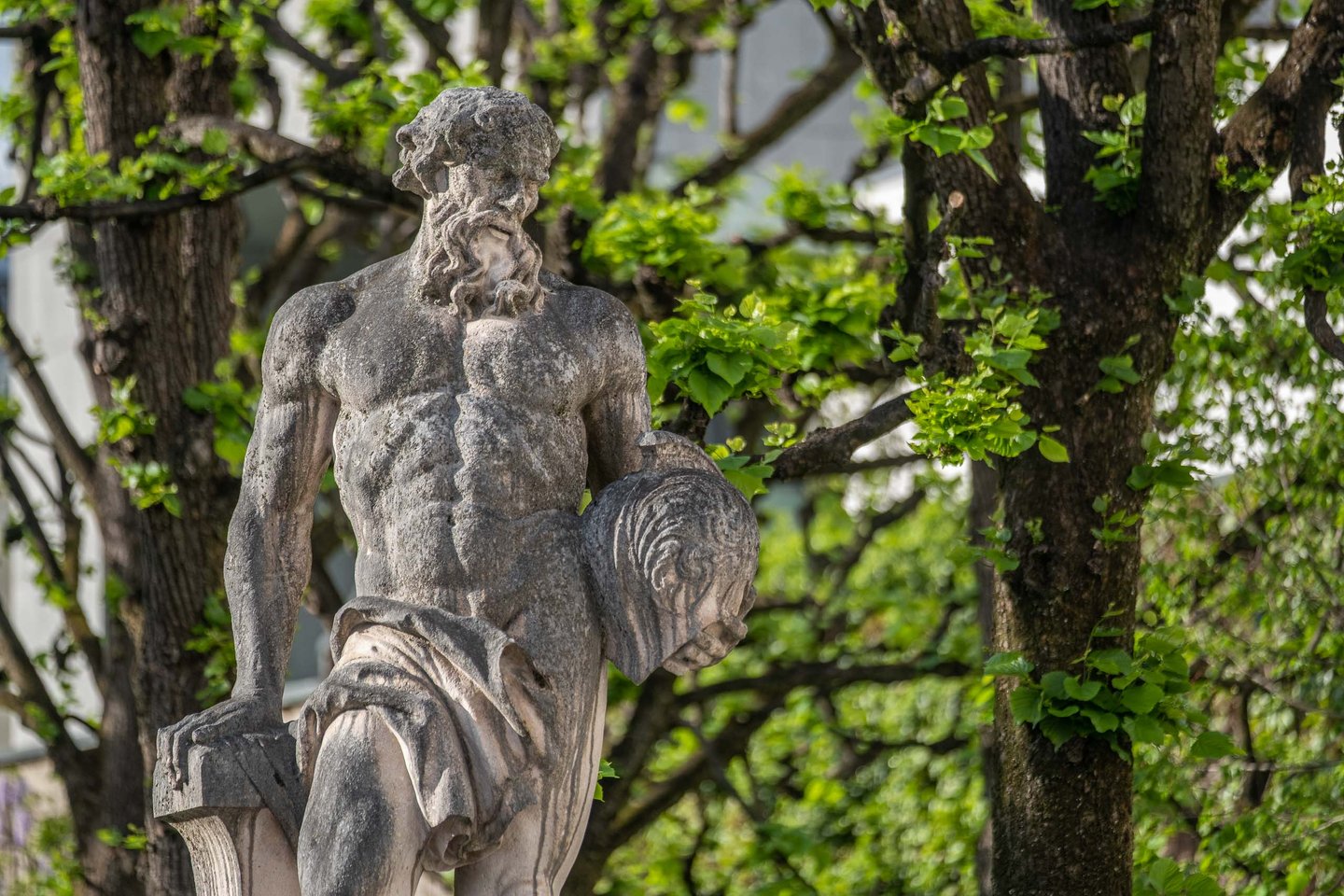
Ares statue at the Mirabell Gardens entrance gate

Mirabell Palace & Gardens

Mirabell Palace & Gardens Guide

Mirabell is the one right-bank sight worth crossing the river for, and most people photograph the steps and leave in ten minutes. Here is what the garden actually holds: an archbishop's mistress, a Rome founding myth told in stone, and seventeen grotesque dwarfs the city had to buy back. Free, every day, and better before the tour buses.

The free half

Walking the garden, in order

The garden rewards a slow loop far more than a photo stop. Everything below is free and outdoors, and it reads as one composed baroque stage aimed straight at the fortress. Enter from Makartplatz and walk toward the palace, the way the guides do.

  1. 1

    The gods at the entrance

    Sixteen Greek and Roman gods flank the gate, and four of the goddesses stand for the four seasons, which mattered more than any deity when your harvest decided your winter.

  2. 2

    The four-element fountain

    Four monumental groups around the central fountain, one per element, each a myth the archbishops wanted read as flattery: Paris for water, Aeneas for fire, Hercules for air, Hades dragging Persephone under for earth.

  3. 3

    The Susanna fountain

    The last surviving piece from Wolf Dietrich's original palace inventory; whether the bathing figure honours his mistress is speculation, but the fifteen children were real.

  4. 4

    The Hedge Theatre

    One of the oldest open-air theatres north of the Alps (1704 to 1718), with a maze beside it that once made musicians appear and vanish mid-performance. Closed in winter.

  5. 5

    The Dwarf Garden

    Seventeen grotesque marble dwarfs, caricatures of real Salzburg courtiers; the original 28 were auctioned off in the Enlightenment, the city recovered 15 in 1919 and two more in 2018. Easy to miss, closed in winter.

  6. 6

    The Pegasus Fountain

    The winged horse originally stood by the cathedral as a symbol of divine backing, was forgotten in an art depot for decades, and landed here in 1913 still facing the cathedral.

  7. 7

    The Do-Re-Mi steps

    The outdoor garden staircase, not any stair inside the palace; also one of the best photo spots in the city, with the fortress in the distance. Go early or share it with a crowd.

Behind the marble

Inside the palace

The palace is a plainer building than the garden, rebuilt simply after the 1818 fire, and most of it is working city offices. Two things inside are genuinely worth the twenty minutes.

  1. The Marble Hall

    One of the finest baroque rooms in Austria, where Mozart performed and over a thousand couples still marry each year; free to see but fenced, so you get the doorway view unless you attend a concert or a wedding.

  2. The Angel Staircase and the Rome story

    Georg Raphael Donner's putti climb beside eleven statues telling the founding of Rome, reassembled in the wrong order after the 1818 fire so Caesar and Brutus greet you at the bottom.

  3. A palace that is a city hall

    Built in 1606 by archbishop Wolf Dietrich for his mistress Salome Alt, renamed by the cousin who had him arrested, and now home to the passport desk and the lost and found.

Sound of Music

Where Do-Re-Mi was filmed

The garden is one of Austria's most visited film locations, and nearly every Do-Re-Mi beat can be physically retraced. The montage ends here: the fencer statues at the gate, the hedge tunnel, the rim of the Pegasus Fountain, one dwarf's head, and the outdoor steps. All free, all walkable in one loop.

The steps people come looking for are the garden staircase by the rose hill, not a palace stair; that is the one distinction the tour crowds get wrong.

Before you go

Before you go

The simplest sight in Salzburg to plan: nothing to book, nothing to pay, just time it right.

  1. Free, every day

    The gardens cost nothing and open daily from about 6am until dusk; the palace Marble Hall is also free on weekday mornings. No ticket, no booking.

  2. When to go

    Early morning gives you the Do-Re-Mi steps and the fortress view without the crowds; the Hedge Theatre and Dwarf Garden close in winter, so the full walk is a warm-season thing.

  3. What to pair it with

    Five minutes from the Altstadt across the Staatsbrucke; combine with the fortress view, then cross the river toward the cathedral and Mozart's Salzburg.

Save your time

What to skip

Five things people go hunting for at Mirabell that are myths, letdowns, or simply not where they think.

  1. The Magic Flute House story

    The hut where Mozart was supposedly locked up to finish the opera is an urban legend; it stood in Vienna and was moved here decades later.

  2. The Mirabell church by the street entrance

    Nearly always locked, and the one way in is the 10am Sunday service. It is no loss to skip.

  3. Walking into the Marble Hall itself

    You get a doorway view unless you attend a wedding or an evening concert.

  4. Budgeting an hour for the palace interior

    It is a ten-minute stop. Most of it is closed because it is a working city hall.

  5. Hunting a grand staircase indoors

    The Do-Re-Mi steps are not inside the palace.

Start on foot

See Mirabell right, then let the old town make sense

Mirabell is a ten-minute walk from the old town, and it clicks into place once you know the streets on the other side of the river. My free walking tour covers the cathedral, Residenzplatz, St. Peter, Getreidegasse, and the festival district in about two hours. Tip based. Then cross the Staatsbrucke and do the garden loop early. I am biased. I founded the tour.

Everything on this page is free and outdoors, so there is nothing to book and no ticket to lose. Give the garden a slow loop instead of a photo and it stops being a stop and becomes the reason to cross the river. I run a free walking tour and send you here because it is genuinely worth your morning, not because anyone pays me to.

Keep reading

All Salzburg guides

This page is the master list. When you know how long you have or what you are after, these go deeper.

Guide

Things to Do in Salzburg

Salzburg is smaller than most visitors expect. You can cross the old town in twenty minutes, and everything worth seeing is packed so tight you trip over history on every corner. Most people give it half a day, then wish they had given it two. I have guided this city for over a decade. Here is what actually earns...

Guide

Mozart in Salzburg

He was born here in 1756 and spent most of his twenties trying to get out. That tension is the honest version of Mozart's Salzburg, and it is more interesting than the chocolate. This is everything in town that still carries his name, sorted by what it actually is, with notes on which parts are worth your morning...

Guide

The Sound of Music in Salzburg

I have walked these film locations for fourteen years, usually with a tour bus parked behind me. Here is the honest version: which stops are the real Salzburg, which are a Hollywood composite stitched together from three different buildings, and which ones I would skip. The hills are real. Some of the rest is set...

Guide

One Day in Salzburg

One day in Salzburg is enough, if you start early, skip the wrong things, and trust that everything worth seeing sits inside a twenty-minute walk. This is the route a local guide actually walks: one river crossing, one native street food, one attraction you pay for, and a four-hundred-year-old beer garden at the...

Guide

Salzburg with Kids: A Local Guide's Family Plan

I do not have children, but I was one here. I grew up in Hallein, fifteen kilometres south of the city, and the trick fountains, the dinosaurs, and the funicular I send families to are the same ones I remember from thirty years ago. Some have not changed at all, which is exactly why I can tell you which ones still...

Guide

Salzburg on a Rainy Day

Salzburg sits against the Alps, so the clouds pile up and let go more often than anyone wants to admit. After fourteen years of guiding here I have stopped fighting it. A grey, wet day pushes you indoors, into the rooms most visitors skip in good weather, and the old town looks its moodiest under a low sky. Here is...

Gerhard, licensed Salzburg guide