Snapshot
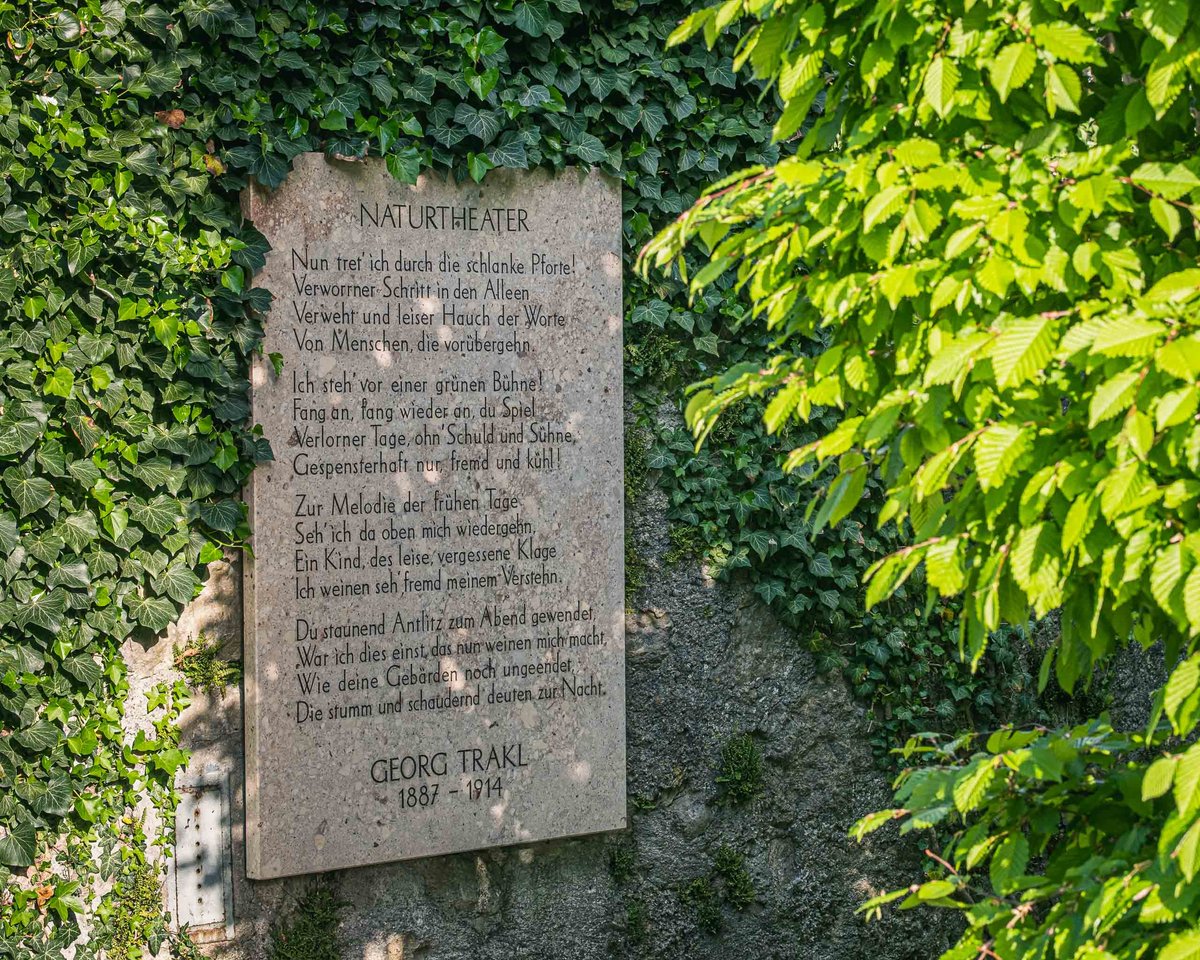
Georg Trakl was born on 3 February 1887 at Waagplatz 2 in the Altstadt, the fifth of seven children in a Protestant merchant family. He became one of the central voices of German-language Expressionism, and his poems remain among the most distinctive and difficult in the language: dense with autumn colour, decay, guilt, and a beauty that never resolves. He died at 27, in Kraków, of a cocaine overdose, in November 1914.
The Story
Trakl grew up in Salzburg and trained as a pharmacist, completing an apprenticeship at the “Zum Weissen Engel” pharmacy in the Altstadt. The work gave him access to morphine and cocaine; his addiction began early and never left him. His sister Grete, four years younger, was the person closest to him throughout his life. His poems were shaped by French Symbolism learned from a governess, by the landscape of Salzburg, and by a Protestant sensibility set apart in a Catholic city.
He published his first collection, Gedichte, in 1913. The publisher Kurt Wolff issued it from Leipzig. Ludwig Ficker, editor of the Innsbruck journal Der Brenner, was his main patron and advocate, and it was Ficker who administered the gift of 20,000 crowns that the philosopher Ludwig Wittgenstein donated to Austrian artists in 1914. Trakl received half.
By then the war had started. Trakl served in the Medical Corps. After the Battle of Grodek in Galicia, he was left responsible for ninety severely wounded soldiers in a barn with almost no medical supplies. Several died while he watched. He suffered a breakdown, attempted suicide, and was taken to a military hospital in Kraków for psychiatric observation. He died there on 3 November 1914 from a cocaine overdose, almost certainly self-administered. He was 27. His final poem, “Grodek,” written in those last weeks, is considered one of the great war poems in any language.
His birthplace at Waagplatz 2 is now the Georg-Trakl-Forschungs- und Gedenkstätte, a research and memorial centre. His sister Grete died by suicide in 1917.