Snapshot
Franz Liszt was the greatest piano virtuoso the world has ever seen. He came to Salzburg in connection with the Mozart centenary of 1856, the year of the hundredth anniversary of Mozart’s birth, drawn to the city that gave Mozart to the world. His own musical lineage connects directly to Mozart’s Vienna: his teacher Salieri was a central figure in the same court world that shaped Mozart.
The Story
Liszt was born in 1811 in a tiny village on the Hungarian-Austrian border, the son of a steward on the Esterhazy estate. He studied under Carl Czerny, Beethoven’s pupil, and under Salieri, who had been at the centre of Viennese musical life throughout Mozart’s career. By the time Liszt was twelve he had already appeared before the Viennese aristocracy, and a whispered story, almost certainly apocryphal, claimed that Beethoven kissed him on the forehead after a private performance in 1823.
His virtuosity was a phenomenon that had no precedent. In the 1840s he toured Europe in a blaze of adulation that the journalist Heinrich Heine named “Lisztomania”: women kept phials of his coffee dregs, fought for his discarded gloves, and broke piano strings to forge into bracelets. He performed over a thousand public concerts in this period, more or less single-handedly inventing the solo piano recital as a format. He then stopped performing entirely in 1847 and moved to Weimar to compose and conduct.
At Weimar he devoted enormous energy to Wagner, whose music he believed was the future of German culture. He sheltered Wagner after the 1849 Dresden uprising, forged papers, and sent money repeatedly over a decade. The two men’s personal and artistic alliance is one of the pivotal relationships in the history of the Salzburg Festival’s repertoire. Wagner’s operas dominate the Festival’s opera programming; that tradition would not exist in its present form without Liszt’s decade of support.
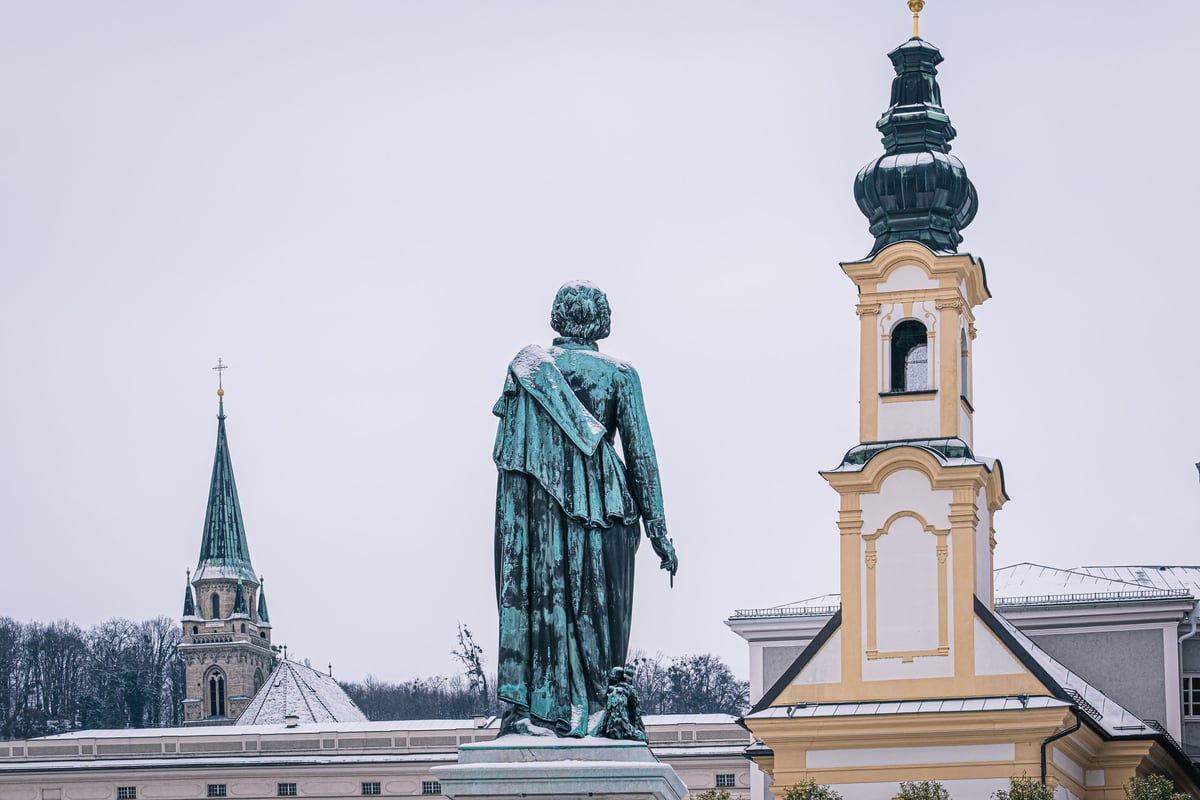
In 1856, the centenary of Mozart’s birth, Liszt came to Salzburg in connection with the commemorations. The city that produced Mozart drew him. His musical lineage traced directly to the Viennese school that had formed Mozart: through Salieri, through Czerny, and through the culture of the Habsburg capital that both men had inhabited. In Salzburg, Liszt belongs to the long history of great musicians who found themselves compelled to honour what the city represents.