
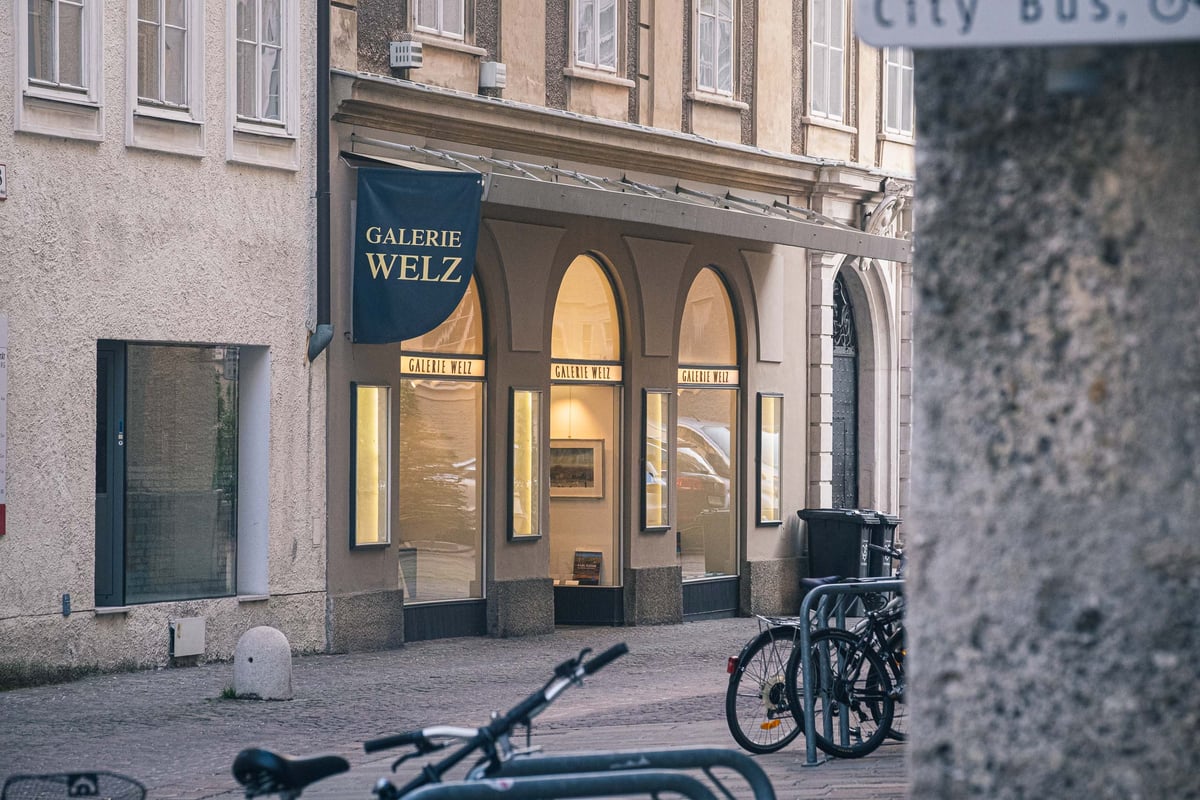
Galerie Welz
20th-21st century
The gallery began as a picture-frame and gilding workshop, the family trade Friedrich Welz (1903-1980) inherited and, in the mid-1930s, turned into one of Austria's most significant commercial art galleries.
Entrepreneur
2 November 1903, Salzburg - 1980, Salzburg
Friedrich Welz built the gallery that brought Klimt, Schiele, and Kokoschka to Salzburg audiences, and he did it from a picture-framing shop his family had run for generations on Sigmund-Haffner-Gasse. The gallery is still there. So is the complicated history that surrounds him.
Welz grew up on Sigmund-Haffner-Gasse, the son of a frame maker. When he took over the shop in 1934, he began hanging art on the walls alongside the frames, and within a year he was organising solo exhibitions for Oskar Kokoschka, showing Klimt prints, and establishing Salzburg as a place where serious modern art could be seen.
He had a genuine eye. The artists he championed in the 1930s were not yet the cultural monuments they would become. Showing them in a provincial city took both confidence and persuasion, and Welz did both.
After the Anschluss in March 1938, the story changes. Welz joined the Nazi Party and used his new position to acquire the Würthle Gallery in Vienna from its Jewish owner Lea Bondi-Jaray, a forced transfer that has been the subject of legal and restitution proceedings ever since. He organised a Hans Makart exhibition in 1940 with Hermann Göring as patron. His wartime role moved from gallerist to active participant in the art market’s most compromised chapter.
A 1976 donation of 650 paintings and 1,400 prints to the Salzburg Museum der Moderne prompted decades of provenance research that is still ongoing. The gallery he founded on Sigmund-Haffner-Gasse, inside the baroque Palais Kuenburg, continues to operate today, holding approximately ten exhibitions a year. It is one of the oldest surviving commercial galleries in Austria. The history of how it was built cannot be separated from the history of how that building was conducted.
Locations
20th-21st century
The gallery began as a picture-frame and gilding workshop, the family trade Friedrich Welz (1903-1980) inherited and, in the mid-1930s, turned into one of Austria's most significant commercial art galleries.
Referenced by
20th-21st century
The gallery began as a picture-frame and gilding workshop, the family trade Friedrich Welz (1903-1980) inherited and, in the mid-1930s, turned into one of Austria's most significant commercial art galleries.