
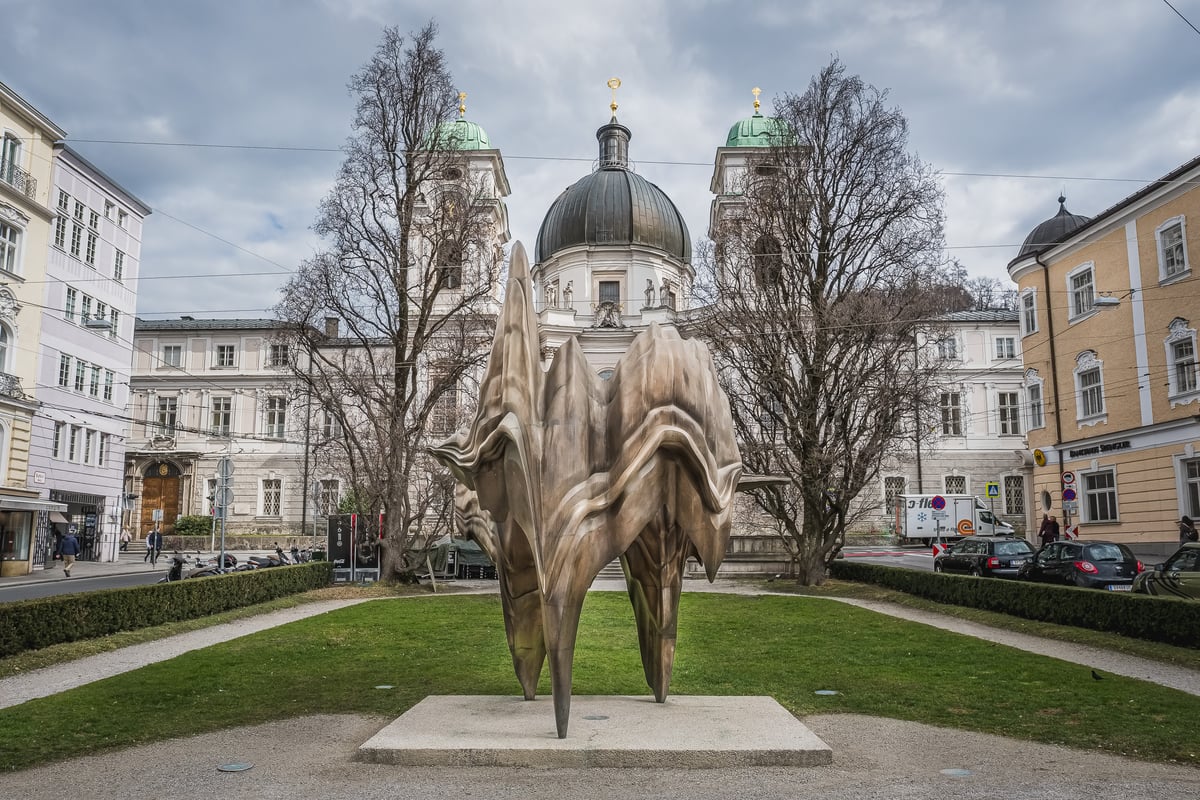
Caldera
Installed 2008
A large bronze sculpture by Tony Cragg on Makartplatz (2008). Walk of Modern Art #6. Organic, swirling form that visitors can enter and experience from within.
Sculptor
9 April 1949, Liverpool, England
A Turner Prize-winning British sculptor whose Caldera (2008) stands on Makartplatz near the Dreifaltigkeitskirche. The large bronze’s swirling, cave-like interior invites visitors to step inside, one of the few Walk of Modern Art commissions you can physically enter.
Tony Cragg started out as a laboratory technician in Liverpool before switching to art school in the late 1960s. That scientific background never left him: he treats material as a subject in its own right, believing that stone, bronze, and glass each carry their own emotional weight before the sculptor touches them. He won the Turner Prize in 1988 and has been based in Wuppertal, Germany for most of his working life, where his studio operates more like a materials research lab than a conventional atelier.
His connection to Salzburg runs deeper than a single work. Caldera arrived on Makartplatz in 2008 as part of the Walk of Modern Art. The bronze stands roughly five metres tall and curves inward to form a cave-like space. You can walk inside. The interior shifts as you move through it, revealing what look like hidden human profiles emerging from the metal walls. For a city that measures its art against Mozart and the Baroque, placing a work this physically strange in one of its central squares said something deliberate.
In 2014 Cragg returned for the Kunstprojekt Krauthugel at the foot of Hohensalzburg Fortress, installing three bronzes, including Points of View and Runner, in the open meadow arena. In 2025 his Zeiten series occupied the state rooms of the DomQuartier, placing glass filigree and stone sculptures inside gilded Baroque interiors. The Baroque rooms did not overwhelm the work. The work pushed back.
His stated philosophy is that sculpture should force the viewer to move, to see 360 degrees, and to let the material answer questions rather than simply decorate a space. Caldera does that. Walking around it is not the same as standing in front of it. Walking inside it is different again.
Locations
Installed 2008
A large bronze sculpture by Tony Cragg on Makartplatz (2008). Walk of Modern Art #6. Organic, swirling form that visitors can enter and experience from within.