
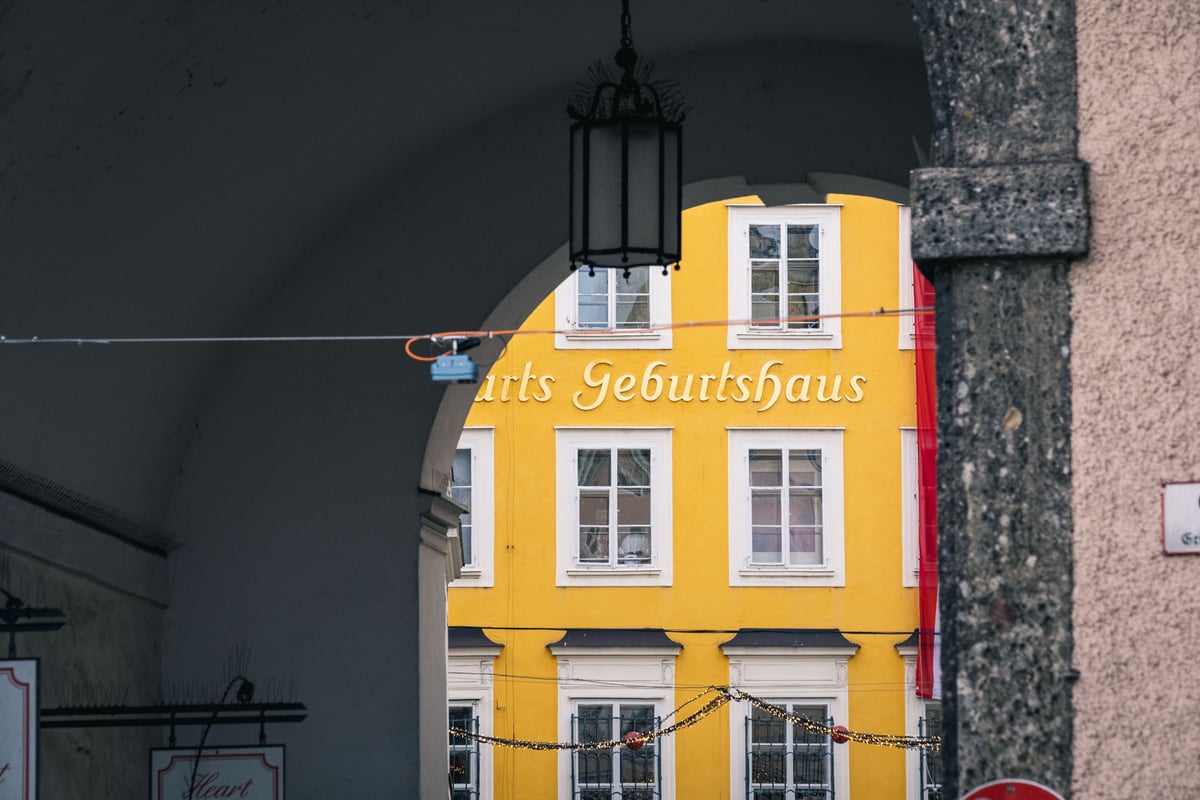
Mozart's Birthplace
Baroque
The third floor of Getreidegasse 9 is where Wolfgang Amadeus Mozart was born on 27 January 1756, and where he spent the first seventeen years of his life.
Painter
8 November 1764, Hof, Bavaria, Germany - 19 February 1825, Munich, Bavaria
Barbara Krafft painted the face of Mozart in 1819, nearly three decades after his death. The portrait she produced became the image the entire world has used ever since to picture the composer who made Salzburg famous.
Krafft was the daughter of an Imperial court painter, trained from childhood in the disciplined techniques of portraiture, and by 1786 she had exhibited at the Vienna Academy of Fine Arts with enough authority to become one of the very few women ever admitted to formal membership. She built a career across the Austrian and Bohemian courts, painting aristocrats, clergy, and the families of merchants who wanted their likenesses recorded in the same tradition as the nobility. In the 1790s she was working in Salzburg, close enough to the Mozart circle to paint Mozart’s sister Nannerl and secure commissions from the archbishop’s court.
The commission that defined her historical legacy came in 1819, commissioned by the Mozarteum Foundation. Mozart had been dead for 28 years. There was no living subject to sit for her; there were only earlier portraits, written descriptions, and the recollections of people who had actually known him. Krafft worked from these materials and produced a composed, dignified likeness, the composer in three-quarter view, calm and contained, the kind of image that could serve as the face of a genius without upstaging the music.
The portrait was not realistic in the sense of being painted from life, but it was authoritative in the sense that it settled the question. This became the Mozart everyone pictured. It appeared in encyclopedias, concert programmes, textbooks, and gift shops. The face tourists see on the chocolate boxes at Mozart’s Birthplace derives from Krafft’s work. The Mozarteum commissioned it to give the city’s most important figure a canonical face, and she delivered one that has held for over two hundred years.
Locations
Baroque
The third floor of Getreidegasse 9 is where Wolfgang Amadeus Mozart was born on 27 January 1756, and where he spent the first seventeen years of his life.