
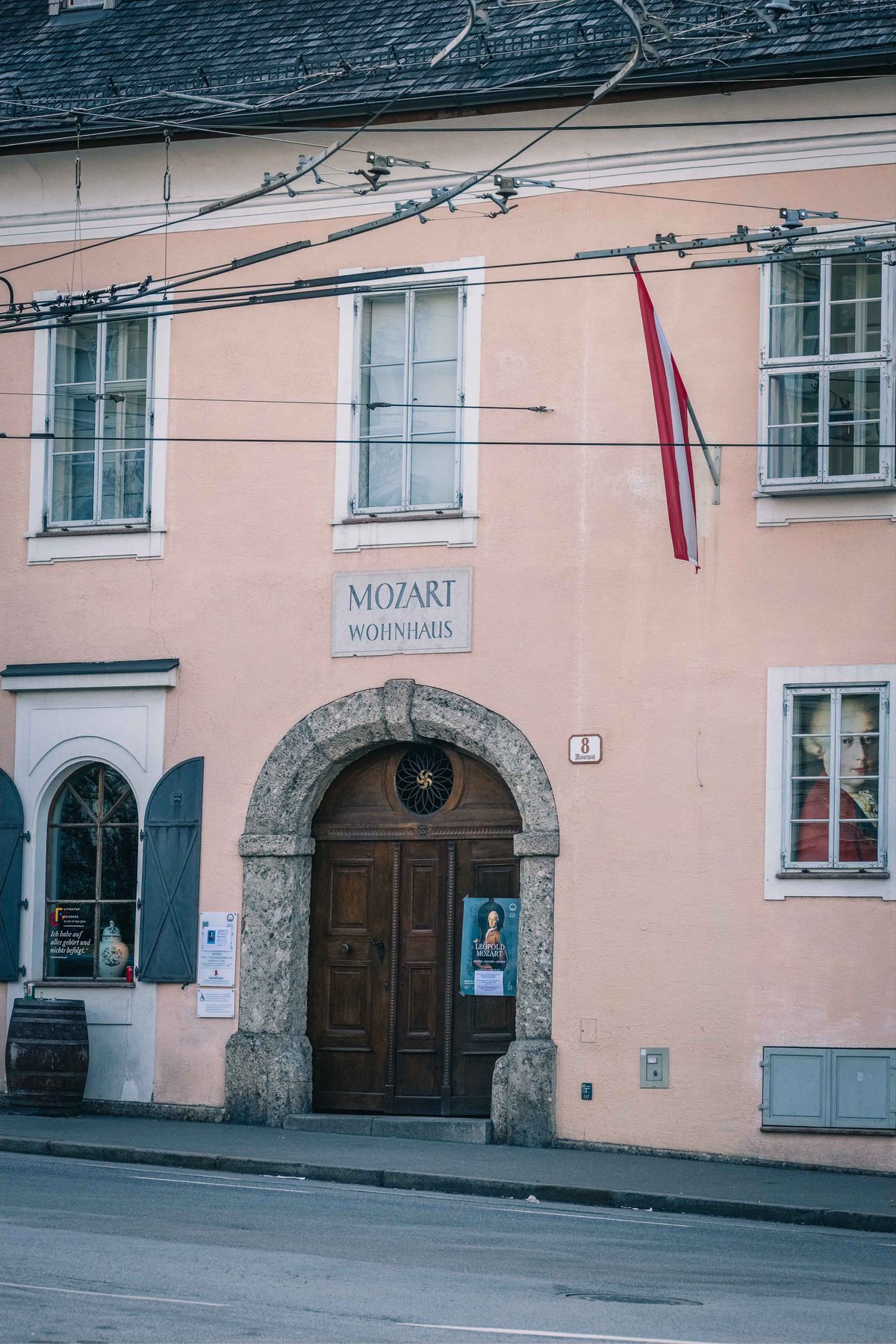
Mozart's Residence
1773
The larger apartment on Makartplatz where the Mozart family moved in 1773. Leopold Mozart lived here until his death in 1787. Wolfgang Amadeus Mozart lived here until his permanent departure for Vienna in 1781.
Composer
26 July 1791, Vienna - 29 July 1844, Karlsbad (Karlovy Vary), Bohemia
Mozart’s younger son was born four months before his father died and spent his life carrying a name that both opened doors and closed them. Franz Xaver Wolfgang Mozart’s most direct Salzburg act was becoming a founding member of the Dommusikverein und Mozarteum, the institution that grew into the Stiftung Mozarteum that guards his father’s legacy today.
Franz Xaver Wolfgang Mozart was born in Vienna on 26 July 1791. His father died on 5 December of that year. He was baptised at St. Stephen’s Cathedral, and grew up in a household shaped entirely by the gravitational pull of a name he had inherited but could never match.
Constanze Mozart ensured both her sons received serious educations. Franz Xaver was sent to Prague to study under Niemetschek, then returned to Vienna for lessons with Salieri, Hummel, and Albrechtsberger, a roster that shows his mother’s ambitions for him. He composed, he performed, he toured. He sometimes performed under the name “Wolfgang Amadeus Mozart Junior” or “W. A. Mozart Sohn,” which reveals both the practical calculation of trading on the name and the difficulty of escaping it.
His longest chapter was in Lemberg (today Lviv in Ukraine), where he spent roughly 30 years teaching piano to noble families, building a musical community, and founding the Saint Cecilia Brotherhood, a choral society that gave the city a more formal musical identity. He conducted his father’s Requiem there in 1826, a symbolic act of inheritance. He was good at what he did, and he made a genuine contribution to musical life in Galicia. But the shadow of the name followed him everywhere.
His tie to Salzburg is through the Dommusikverein und Mozarteum, which he helped found. That institution evolved over the 19th century into the Stiftung Mozarteum, which today runs the Universitat Mozarteum, maintains the archives, and organises the Mozartwoche festival. Franz Xaver Wolfgang never became a great composer. But by helping to establish the body that would preserve and promote his father’s work, he contributed to Salzburg’s ongoing claim on Mozart’s legacy in a way that has proven more durable than any of his own compositions.
Locations
1773
The larger apartment on Makartplatz where the Mozart family moved in 1773. Leopold Mozart lived here until his death in 1787. Wolfgang Amadeus Mozart lived here until his permanent departure for Vienna in 1781.