
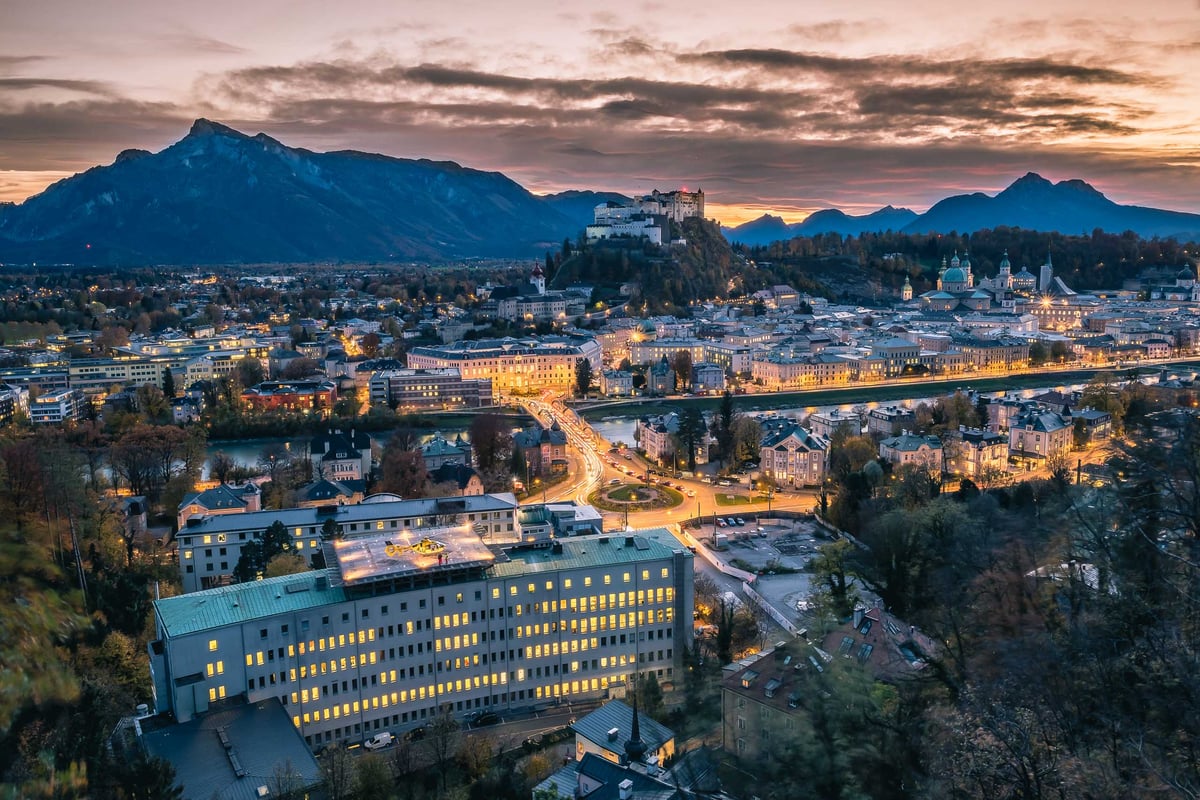
Kapuzinerberg
The Kapuzinerberg is Salzburg's right-bank wooded hill, directly across the Salzach from the Altstadt, and the best panoramic viewpoint in the city for visitors willing to walk 15 minutes uphill.
Writer
28 November 1881, Vienna - 22 February 1942, Petropolis, Brazil (suicide in exile)
Stefan Zweig was one of the most widely translated authors of the 20th century. Born in Vienna in 1881 to a prosperous Jewish family, he became a biographer, novella writer, playwright, and finally a memoirist whose farewell to pre-war European civilisation remains in print in dozens of languages. He lived at Kapuzinerberg 5, Salzburg, from 1919 to 1934. The house, a crumbling 17th-century villa called the Paschinger Schlössl, became the most celebrated literary address in the German-speaking world between the wars.
Zweig and his wife Friderike bought the ruin on the Kapuzinerberg in 1917 for 12,000 crowns. The roof was sagging, there was no electricity, no running water, no telephone. They restored it slowly, and by 1919 it had become a working home. Over the following fifteen years, Zweig wrote his biographies of Erasmus, Marie Antoinette, and Mary Queen of Scots, his novella Amok, and the essay collection that made him a pan-European voice for humanist values. Thomas Mann came. Hugo von Hofmannsthal came. James Joyce and H.G. Wells came. Café Bazar was his local. The letters flew across borders.
Then the politics changed. In 1934, after Austrian police searched the villa for weapons under the austrofascist regime then in power, Zweig left Salzburg and never returned. He went to London, then to Bath, then to New York, then to Petrópolis in Brazil. In exile, he wrote Die Welt von Gestern (The World of Yesterday), his memoir of the secure cosmopolitan world that had been destroyed. He finished it in late 1941. On 22 February 1942, he and his second wife Lotte took their own lives. He was 60.
The archive is held at the Stefan Zweig Centre Salzburg, at the University of Salzburg. The Paschinger Schlössl still stands on the Kapuzinerberg, now in private ownership.
Locations
The Kapuzinerberg is Salzburg's right-bank wooded hill, directly across the Salzach from the Altstadt, and the best panoramic viewpoint in the city for visitors willing to walk 15 minutes uphill.