
Square
Waagplatz
Snapshot
A quiet square in the Altstadt where a medieval weighing station gave the space its name, where the city’s courthouse once held executions, and where Georg Trakl, Salzburg’s greatest poet, was born in 1887.
The Story
Waagplatz is a few minutes’ walk from Residenzplatz but sits outside the main tourist flow, which gives it a different quality from the city’s bigger squares. The name is straightforward: “Waag” means scales, and the official grain-weighing station stood at No. 3 from the 15th century until 1815, measuring every sack of grain, barley, and rye that came through the Altstadt market. The city owned and operated the scales as a public authority. The square took the name from the building that defined its function for four centuries.
Before the weighing station, the square held a courthouse, from 1328 to 1407, with dungeons in the southwest corner and a public pillory where executions took place in the square itself. Records document a hanging in 1342, a beheading in 1389, and a burning in 1405. After 1407 the courthouse became the scale house; the pillory was moved to Griesgasse in the early 17th century. Commerce replaced justice on the same cobblestones.
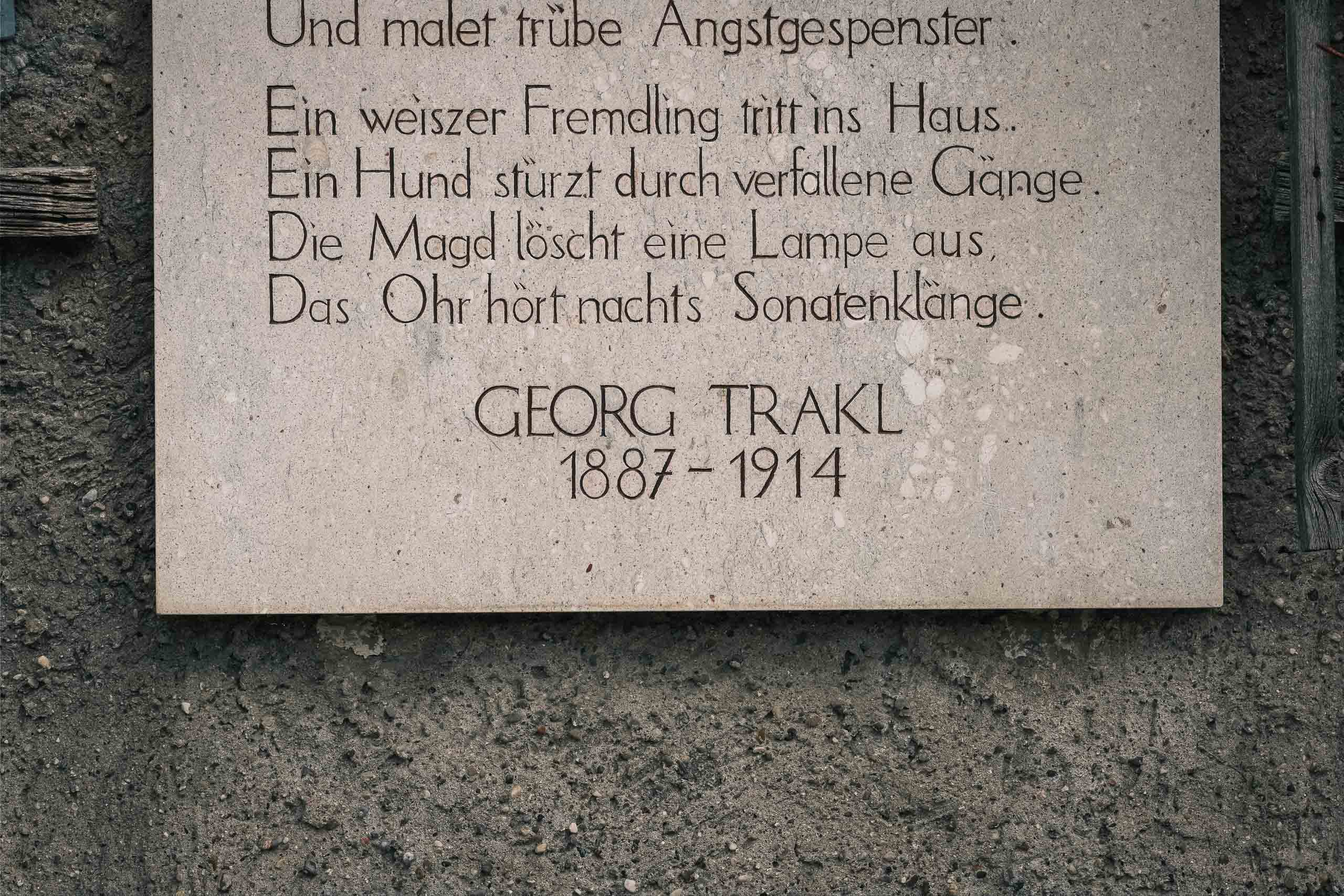
At No. 2 stands the Georg Trakl Haus, the birthplace of Georg Trakl, born here on 3 February 1887. Trakl is the defining literary figure associated with Salzburg: an Austrian expressionist poet whose work uses images of decay, guilt, and a strange luminous ruin to describe a world coming apart. He died of a cocaine overdose in Krakow in November 1914, age 27, shortly after witnessing the catastrophic Battle of Grodek as a medical orderly. The documentation center in the house holds manuscripts and materials from his life and work.
The facade of the tavern at No. 1 carries a sgraffito mural, “Aussaat und Ernte” (Sowing and Harvest), painted in 1928 by Karl Reisenbichler and commissioned by an insurance company after a 1635 fire destroyed the original building. It is one of the more unusual facade decorations in the Altstadt, worth a look.
Visiting
The square is always accessible, free. Enter from Judengasse from the south or from the Mozartplatz direction from the east. The Georg Trakl Haus documentation center has limited opening hours; check in advance. The sgraffito mural on No. 1 is visible from the square. Combine with Judengasse for the southern Altstadt’s quieter lanes, and Residenzplatz for the monumental contrast.