Gulasch
A deep, paprika-rich beef stew, the Austrian adaptation of the Hungarian original. Thick enough to coat a spoon, served with bread dumplings. On a cold afternoon in Salzburg it is one of the most satisfying things the…
What Gulasch actually is
A deep, paprika-rich beef stew, the Austrian adaptation of the Hungarian original. Thick enough to coat a spoon, served with bread dumplings. On a cold afternoon in Salzburg it is one of the most satisfying things the city's food culture offers.
The Story
Austrian Gulasch and its Hungarian ancestor, Gulyás, look related but are not the same dish. The Hungarian original is closer to a broth, a herder's pot of meat and paprika thinned with water. The Austrian version, which arrived in Vienna during the 19th century as the Habsburg Empire absorbed and adapted Hungarian culture, is thicker and richer: built on a foundation of onions cooked down slowly until they dissolve into a dark, sweet base, then combined with sweet paprika, a little tomato, beef, and stock, and simmered for two to three hours until the sauce is deep and clings to everything.
It is now so embedded in Austrian cooking that most people eating it in a Salzburg restaurant do not think of it as foreign. It appears on traditional menus alongside Schweinsbraten and Salzburger Bierfleisch as a standard main course. The arrival of a bowl with Semmelknödel alongside is the complete picture: the dumplings soak up the sauce, and the paprika warmth of the stew carries the whole meal.
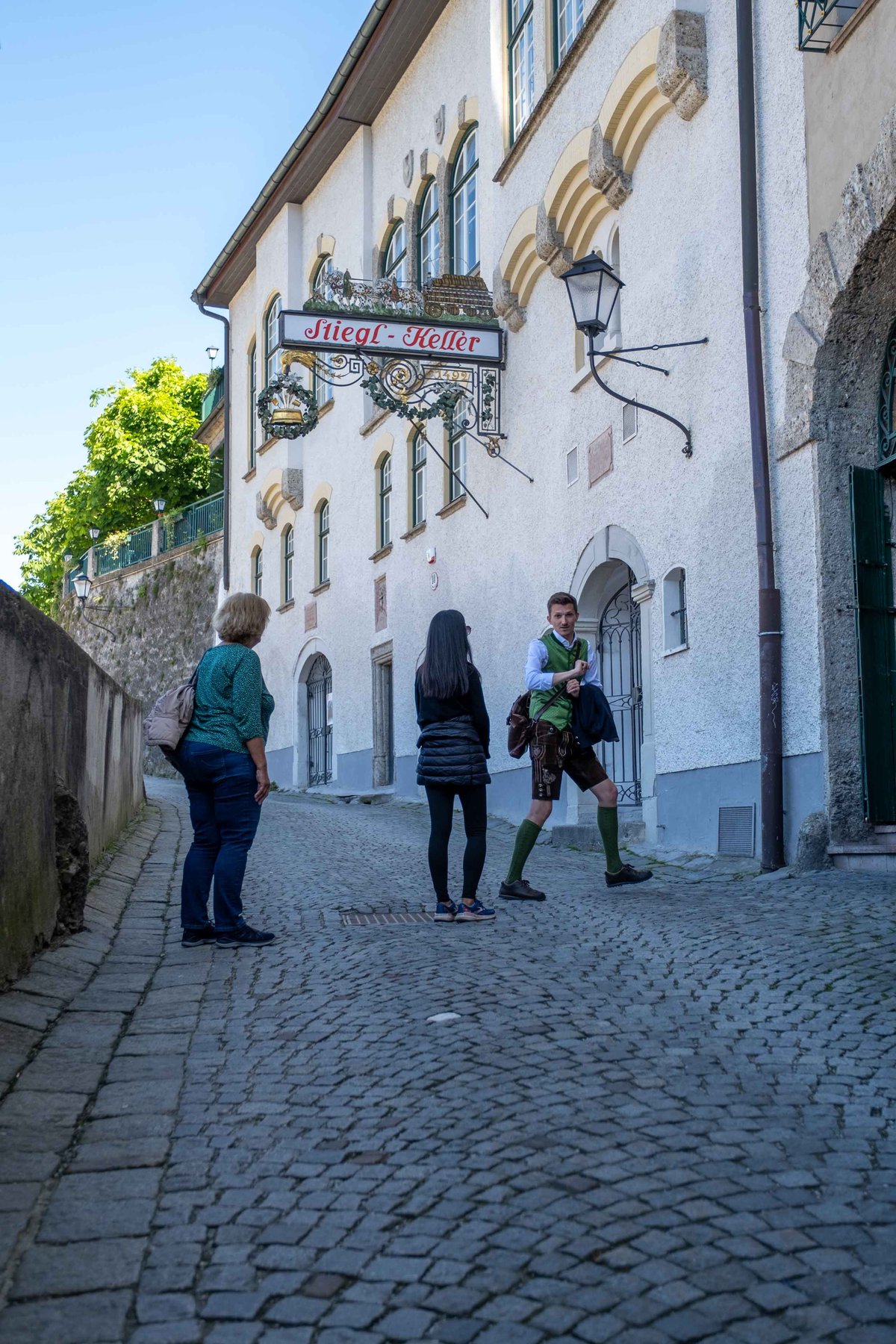
The dish is a reliable indicator of a kitchen's patience. Gulasch cannot be rushed; the long simmer is what converts the onion and paprika base from raw ingredients into something with depth. In Salzburg, Stiftskeller St Peter and Stieglkeller serve versions that take it seriously. On a cold afternoon, it is one of the most complete expressions of Austrian comfort food available in the city.

Other Salzburg dishes
What Gulasch actually is
A deep, paprika-rich beef stew, the Austrian adaptation of the Hungarian original. Thick enough to coat a spoon, served with bread dumplings. On a cold afternoon in Salzburg it is one of the most satisfying things the city's food culture offers.
The Story
Austrian Gulasch and its Hungarian ancestor, Gulyás, look related but are not the same dish. The Hungarian original is closer to a broth, a herder's pot of meat and paprika thinned with water. The Austrian version, which arrived in Vienna during the 19th century as the Habsburg Empire absorbed and adapted Hungarian culture, is thicker and richer: built on a foundation of onions cooked down slowly until they dissolve into a dark, sweet base, then combined with sweet paprika, a little tomato, beef, and stock, and simmered for two to three hours until the sauce is deep and clings to everything.
It is now so embedded in Austrian cooking that most people eating it in a Salzburg restaurant do not think of it as foreign. It appears on traditional menus alongside Schweinsbraten and Salzburger Bierfleisch as a standard main course. The arrival of a bowl with Semmelknödel alongside is the complete picture: the dumplings soak up the sauce, and the paprika warmth of the stew carries the whole meal.
The dish is a reliable indicator of a kitchen's patience. Gulasch cannot be rushed; the long simmer is what converts the onion and paprika base from raw ingredients into something with depth. In Salzburg, Stiftskeller St Peter and Stieglkeller serve versions that take it seriously. On a cold afternoon, it is one of the most complete expressions of Austrian comfort food available in the city.
Other Salzburg dishes

Editor's table
Where we send friends
Restaurants, cafes, and bars Gerhard returns to. Curated, not comprehensive.
Pantry
What grows in the region
“Save one evening for Salzburger Nockerl, and order it for two.”
It is the one Salzburg dish I have not shown you a photo of, because a photo cannot do it justice and the ones online are usually someone else’s. Three baked peaks of sweet soufflé dusted with sugar, meant to look like the snow on the city’s three hills. It collapses within minutes, so it is always made fresh and always shared. Get it at a proper restaurant, not a tourist trap, and watch it arrive still trembling. That is the meal people remember.
From the kitchen
Try a Salzburg classic
Snack
Bosna
A spiced bratwurst in a white roll, invented in 1949 by a Bulgarian immigrant, and now the closest thing Salzburg has to its own…
Drink
Glühwein
Mulled red wine with cinnamon, cloves, star anise, and orange peel, served steaming in a ceramic cup at the Christmas markets. The smell of…
Main Course
Gulasch
A deep, paprika-rich beef stew, the Austrian adaptation of the Hungarian original. Thick enough to coat a spoon, served with bread dumplings. On a…


