
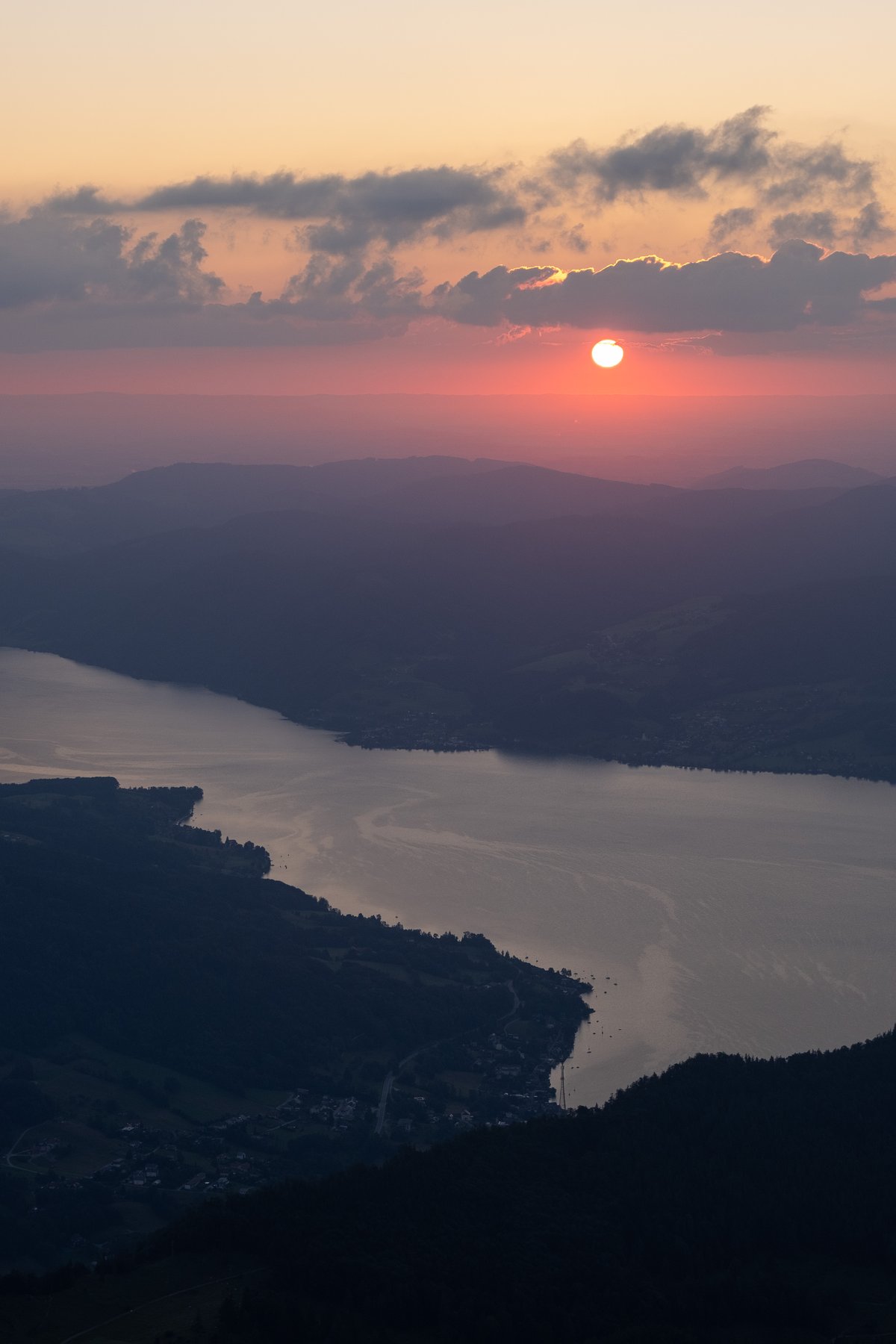
Attersee
Gustav Klimt spent summers at the Attersee from 1900 to 1916, producing a series of landscape paintings that documented the lake from specific points along its shores.
Village / Austria
1 place
Austria’s largest lake sitting entirely within its own borders, the Attersee is famed for water so clear you can see the bottom at 10 metres. Gustav Klimt returned here summer after summer for fourteen years; Gustav Mahler wrote two symphonies on its shore. Sailors, divers, and cyclists have claimed it ever since.
The Attersee lies in the Upper Austrian Salzkammergut, larger and slightly less visited than its neighbours Wolfgangsee and Mondsee. Its exceptional clarity comes from the catchment geology: limestone-filtered Alpine streams feed a basin that reaches over 170 metres at its deepest point. That same transparency makes it Austria’s best freshwater diving destination, with submerged prehistoric pile-dwelling remains among the attractions.
The late nineteenth century brought the Viennese intelligentsia by train. Gustav Klimt arrived first in 1900 and kept returning, painting the shimmering lake surface and the gardens of the lakeside villas in a style quite different from his studio portraits. Gustav Mahler worked at a lakeside composing hut in Steinbach, completing his 2nd Symphony and drafting the 3rd. Theodor Billroth, the pioneering surgeon and close friend of Johannes Brahms, also summered on the eastern shore, and Brahms visited repeatedly.
Today the lake is primarily a sailing and outdoor destination. The Attersee circuit, roughly 45 kilometres of mostly flat lakeside road, is one of the easier and more scenic cycling loops in the Salzkammergut region. Several boat services connect the main villages across the water.
The Klimt connection has grown into a minor cultural circuit: a trail links the spots where he set up his easel, with reproductions positioned at the original viewpoints. Attersee village itself, on the northwest shore, holds a small Klimt memorial. The composer’s hut at Steinbach is gone, but a memorial marks the site.
Getting there: Attersee is roughly 60-70 km from Salzburg, accessed via the A1 motorway east toward Linz, then south at Regau or Vöcklamarkt. Allow around an hour by car. Train access is possible via Vöcklabruck on the Westbahn line, then a regional bus, but connections are infrequent.
Combining: pairs well with Bad Ischl (about 30 km south) for a fuller Salzkammergut day. Wolfgangsee and Mondsee are both under 30 km away. A two-lake day combining Attersee and Mondsee is comfortable by car.
When to visit: June to September for swimming and cycling. Sailing regattas run through summer. The Klimt trail is accessible year-round but most pleasant May-October.
Practical: The lake is in Upper Austria (not Salzburg State), so overnight stays are slightly outside the IS core. Day trip framing is most appropriate. No admission charges for lake access. Boat trips around the lake run seasonally.
Mapped places
Every card is assigned directly to this destination or one of its canonical child destinations.