One of the five co-founders of the Salzburg Festival (1920), alongside Hofmannsthal, Reinhardt, Strauss, and Schalk. A founding member of the Vienna Secession and close collaborator of Gustav Mahler, Roller's visual language helped shape the aesthetic identity of the Festival from its opening season.
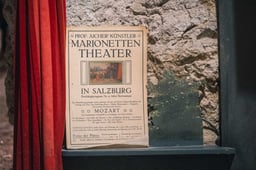
Styrian-born puppeteer who founded the Salzburger Marionettentheater in 1913, one of the most celebrated puppet theatres in the world. His family ran the theatre for three generations, until his granddaughter Gretl Aicher died in 2012; it is now led by non-family directors.
Austrian light and neon artist whose Beyond Recall (2011) on the Staatsbrucke confronts visitors crossing Salzburg's main bridge with four neon cubes addressing the Nazi period and the imperative of remembrance.
French conceptual artist whose Vanitas (2009) in the Romanesque crypt beneath Salzburg Cathedral places twelve sheet-metal figures casting shifting candlelit shadows alongside a recorded voice announcing the time. The work resonates powerfully with the Jedermann tradition performed outside on the Cathedral forecourt every summer since 1920.
Austrian conceptual artist best known for his One Minute Sculptures. His Gurken (2011), a cluster of oversized cucumber sculptures in Furtwanglerpark, is a characteristic provocation that places the comic in a formal baroque garden context.
American artist who works exclusively with light and space. His Sky Space (2006) at the Museum der Moderne on Monchsberg is a permanent chamber with an elliptical aperture open to the sky, one of the few Turrell Sky Spaces permanently accessible to the public in a European museum.
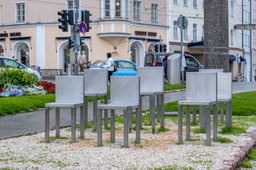
The godmother of performance art. Marina Abramovic's Spirit of Mozart (2004) is a stainless-steel chair sculpture at the northern bridgehead of the Staatsbrucke, a tall central chair ringed by smaller ones for quiet contemplation, honouring the city's most famous son through an artist whose practice is built on presence, duration, and the invisible.
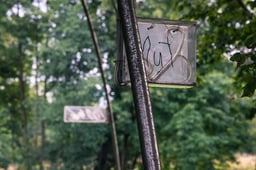
One of the leading figures of Arte Povera. His Ziffern im Wald (2003), the second Walk of Modern Art commission, installed Fibonacci numerals in neon on the trees of the Monchsberg forest, visible at night from below. A mathematical poem written across the hill that watches over the city. Merz died the same year the work was completed.