Wiener Schnitzel
Austria's most ordered dish: thin veal pounded flat, coated in flour, egg, and breadcrumbs, and fried in clarified butter until the coating billows and blisters. The name is legally protected. Only veal is Wiener…
What Wiener Schnitzel actually is
Austria's most ordered dish: thin veal pounded flat, coated in flour, egg, and breadcrumbs, and fried in clarified butter until the coating billows and blisters. The name is legally protected. Only veal is Wiener Schnitzel.
The Story
Austrian food law has been unusually firm on one point since 1975: a Wiener Schnitzel must be veal. A pork version is Schnitzel Wiener Art, meaning it follows the technique but not the original meat. The distinction sounds pedantic until you are standing at a menu in a Salzburg Gasthaus trying to decide. The veal version has a more delicate, fine-grained texture and a richer fat. The pork version is cheaper and nearly as good. Both are cooked the same way. The menu is required by law to tell you which is which.
The technique is what defines the dish as much as the meat. The cutlet is pounded to about 3-4mm, a thickness that would seem to leave nothing, then salted, floured, dipped in beaten egg, and pressed into fine fresh breadcrumbs. It goes into hot clarified butter in a pan deep enough to let the coating float free of the meat surface as it cooks. This separation is intentional: the coating puffs, blisters, and develops the wellige, wavy texture that marks a correctly fried schnitzel. A schnitzel that lies flat against the meat has been fried wrong, in too little fat or at too low a temperature.
Served with a wedge of lemon and a plate of potato-cucumber salad (Kartoffel-Gurken-Salat), dressed with vinegar and a little oil. The lemon is not a garnish; you squeeze it. The salad is light and slightly acidic, which is exactly what the fat from the butter requires as a counterpoint. No sauce. Schnitzel does not need sauce.
Where to try it
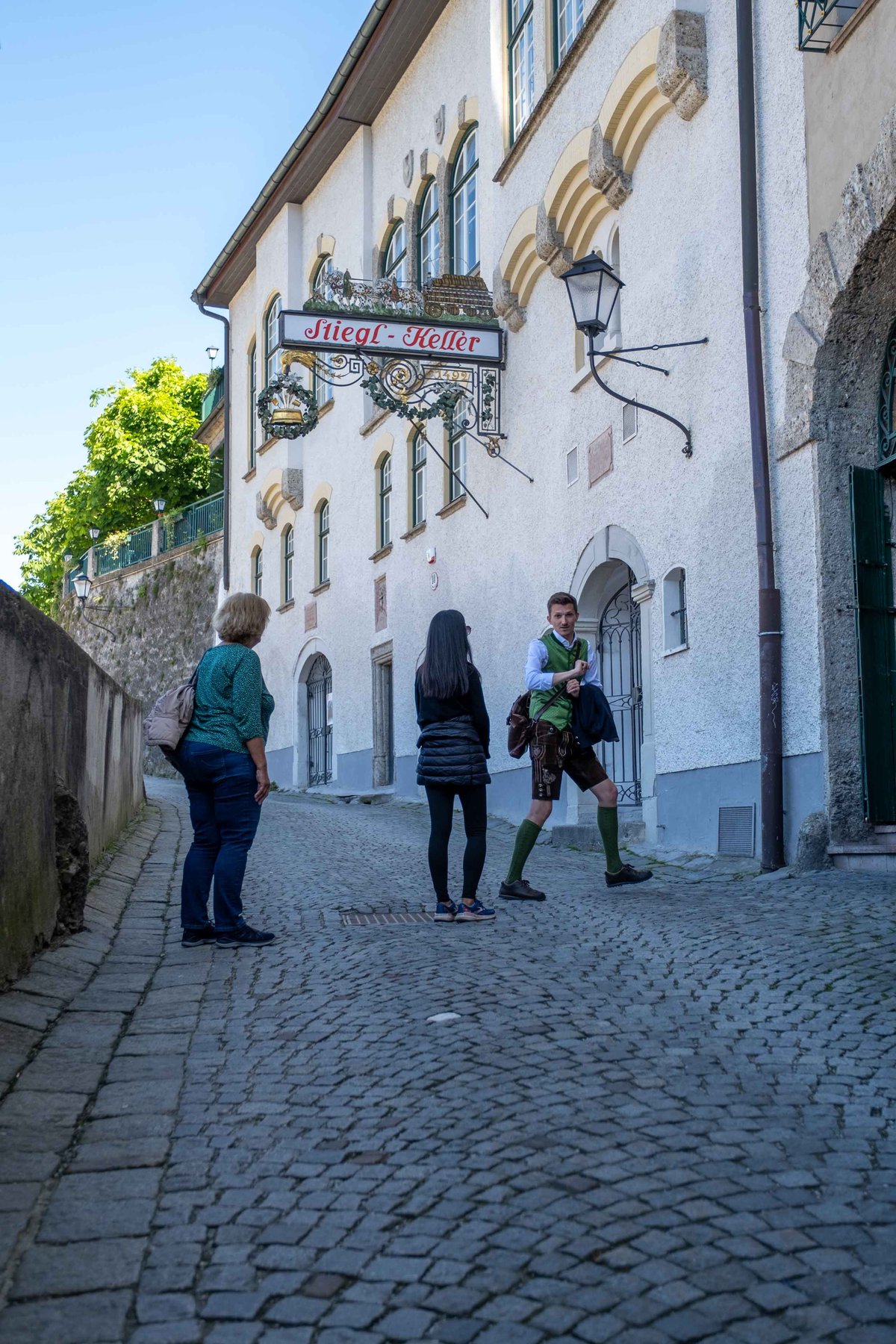
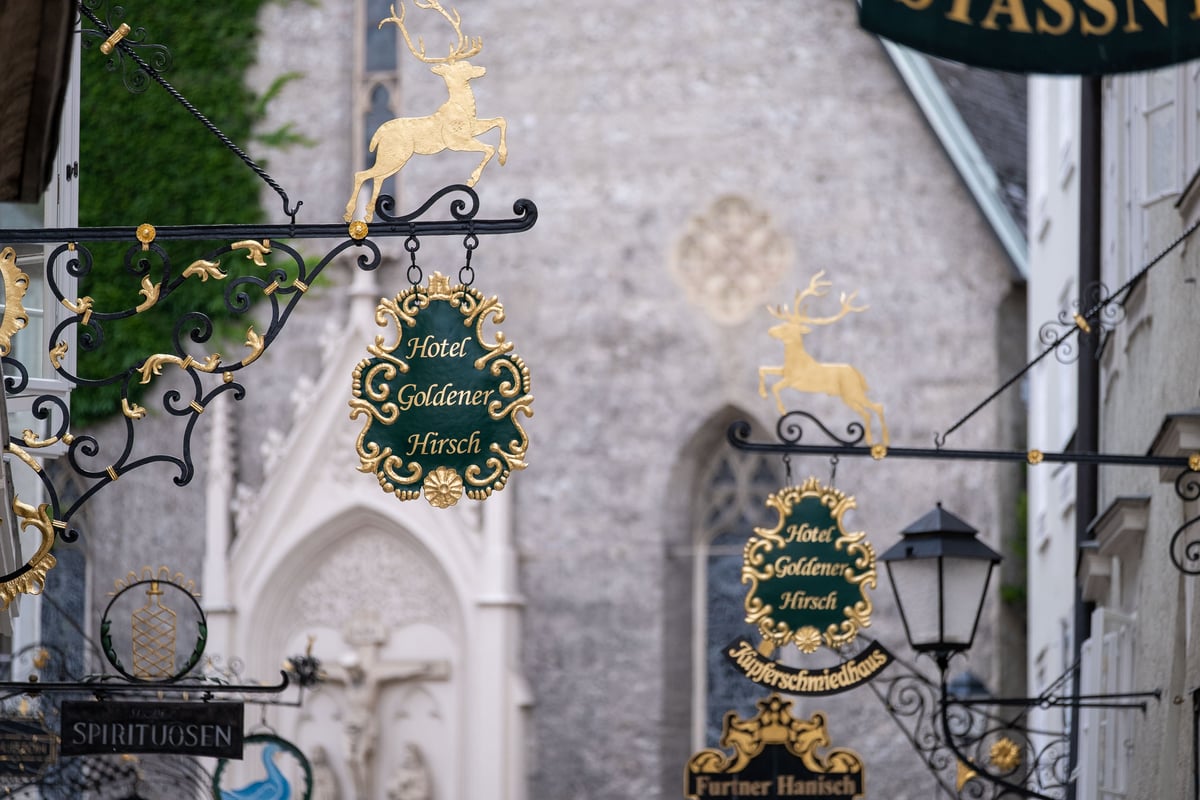
Stiftskeller St Peter, Stieglkeller, and Hotel Goldener Hirsch are among the reliable Salzburg addresses for a correctly made version. Every traditional Gasthaus in the city has it on the menu. The difference between a good Schnitzel and a mediocre one is mostly fat temperature and breadcrumb freshness, which is not always visible from the outside of a restaurant.

Other Salzburg dishes
What Wiener Schnitzel actually is
Austria's most ordered dish: thin veal pounded flat, coated in flour, egg, and breadcrumbs, and fried in clarified butter until the coating billows and blisters. The name is legally protected. Only veal is Wiener Schnitzel.
The Story
Austrian food law has been unusually firm on one point since 1975: a Wiener Schnitzel must be veal. A pork version is Schnitzel Wiener Art, meaning it follows the technique but not the original meat. The distinction sounds pedantic until you are standing at a menu in a Salzburg Gasthaus trying to decide. The veal version has a more delicate, fine-grained texture and a richer fat. The pork version is cheaper and nearly as good. Both are cooked the same way. The menu is required by law to tell you which is which.
The technique is what defines the dish as much as the meat. The cutlet is pounded to about 3-4mm, a thickness that would seem to leave nothing, then salted, floured, dipped in beaten egg, and pressed into fine fresh breadcrumbs. It goes into hot clarified butter in a pan deep enough to let the coating float free of the meat surface as it cooks. This separation is intentional: the coating puffs, blisters, and develops the wellige, wavy texture that marks a correctly fried schnitzel. A schnitzel that lies flat against the meat has been fried wrong, in too little fat or at too low a temperature.
Served with a wedge of lemon and a plate of potato-cucumber salad (Kartoffel-Gurken-Salat), dressed with vinegar and a little oil. The lemon is not a garnish; you squeeze it. The salad is light and slightly acidic, which is exactly what the fat from the butter requires as a counterpoint. No sauce. Schnitzel does not need sauce.
Where to try it
Stiftskeller St Peter, Stieglkeller, and Hotel Goldener Hirsch are among the reliable Salzburg addresses for a correctly made version. Every traditional Gasthaus in the city has it on the menu. The difference between a good Schnitzel and a mediocre one is mostly fat temperature and breadcrumb freshness, which is not always visible from the outside of a restaurant.
Other Salzburg dishes

Editor's table
Where we send friends
Restaurants, cafes, and bars Gerhard returns to. Curated, not comprehensive.
Pantry
What grows in the region
“Save one evening for Salzburger Nockerl, and order it for two.”
It is the one Salzburg dish I have not shown you a photo of, because a photo cannot do it justice and the ones online are usually someone else’s. Three baked peaks of sweet soufflé dusted with sugar, meant to look like the snow on the city’s three hills. It collapses within minutes, so it is always made fresh and always shared. Get it at a proper restaurant, not a tourist trap, and watch it arrive still trembling. That is the meal people remember.
From the kitchen
Try a Salzburg classic
Snack
Bosna
A spiced bratwurst in a white roll, invented in 1949 by a Bulgarian immigrant, and now the closest thing Salzburg has to its own…
Drink
Glühwein
Mulled red wine with cinnamon, cloves, star anise, and orange peel, served steaming in a ceramic cup at the Christmas markets. The smell of…
Main Course
Gulasch
A deep, paprika-rich beef stew, the Austrian adaptation of the Hungarian original. Thick enough to coat a spoon, served with bread dumplings. On a…