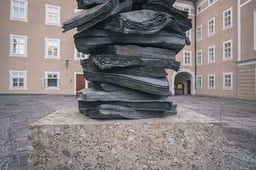
One of the most significant artists of the post-war era. Kiefer has the unique distinction of two permanent Walk of Modern Art commissions in Salzburg: AEIOU (2002), the inaugural commission, and Die Sprache der Vogel (2019), the last and largest work in the series.
Salzburg-born Expressionist whose frescoes for the Grosses Festspielhaus entrance hall (1926) were destroyed by the Nazis as "degenerate art" and later reconstructed. A close friend of Egon Schiele and Oskar Kokoschka. Died at 42.
The painter who created the most widely reproduced image of Mozart. Her 1819 posthumous portrait, painted nearly three decades after Mozart's death, became the face most people picture when they think of Mozart.
The supreme figure of Viennese Jugendstil and co-founder of the Vienna Secession. Klimt spent fourteen consecutive summers (1900-1916) at Attersee in the Salzkammergut, producing the remarkable landscape paintings that stand apart from his gilded figure work.
One of the most celebrated painters of 19th-century Europe, born in Salzburg. So dominant was his influence that the term Makart-Stil entered the language. Makartplatz (where Mozart's Residence stands) was named in his honour. He died in Vienna at just 44.
The most important Austrian baroque painter of his generation and the founder of the Austrian baroque painting tradition. In Salzburg his frescoes crown the dome of the Kollegienkirche and the Dreifaltigkeitskirche, the two Fischer von Erlach churches.
Salzburg-born painter who created the monumental 360-degree Panorama of Salzburg (completed 1829), painted from the Monchsberg. The panorama made Salzburg's silhouette one of the most widely seen urban images of the 19th century, long before photography. Now preserved in the Salzburg Museum.
German Neo-Expressionist whose Homage to Mozart (2005) at Ursulinenplatz depicts Mozart in a loose, semi-abstract style that departs entirely from the idealised portrait tradition. The most aggressively modernist Mozart monument in the city.
Italian-born Austrian baroque painter whose altar paintings remain in Stift St. Peter, the abbey that Saint Rupert himself founded. The third member of the painter trio that defined Salzburg's baroque visual world alongside Rottmayr and Troger.
One of the greatest artists of the late Gothic period in the German-speaking world. Pacher died in Salzburg in 1498. His masterpiece, the St. Wolfgang Altarpiece (1481), stands in the Pfarrkirche St. Wolfgang and is considered one of the supreme achievements of late Gothic art in Central Europe.
One of the great Expressionist painters, and the founder of the Schule des Sehens (School of Vision), a legendary painting school held at Hohensalzburg Fortress from 1953 as part of the International Summer Academy. Every summer, artists from across the world gathered at the fortress to study under Kokoschka.
The leading Austrian baroque fresco painter after Rottmayr. Troger's Salzburg ceilings include his Glory of Saint Cajetan in the Kajetanerkirche and frescoes in Mirabell Palace. If Rottmayr's domes crown the Kollegienkirche and the Dreifaltigkeitskirche, Troger is the other great baroque hand on the city's vaults.
The great Austrian watercolourist whose detailed, luminous views of Salzburg constitute one of the most important visual records of the city in the 19th century. In 1897, at the age of 84, he became the first honorary president of the Vienna Secession.