Kaiserschmarrn
A caramelised, torn pancake dusted with icing sugar and served with stewed plums. Substantial enough for a light main, delicate enough for dessert. On virtually every traditional menu in Salzburg from mountain huts to…
What Kaiserschmarrn actually is
A caramelised, torn pancake dusted with icing sugar and served with stewed plums. Substantial enough for a light main, delicate enough for dessert. On virtually every traditional menu in Salzburg from mountain huts to city restaurants.
The Story
Kaiserschmarrn starts as a pancake batter enriched with whipped egg whites for lightness. It goes into a buttered pan, cooks briefly until set on the edges but still soft in the centre, then gets torn into irregular pieces with two forks or spatulas and tossed until the torn edges caramelise in the butter and sugar. The result is a pile of soft, slightly crisp fragments, dusted with icing sugar and served with a small dish of Zwetschkenröster: stewed plums cooked down with sugar and a little lemon until they become a thick, sour-sweet compote.
The name translates as "Emperor's mess," and the story attached to it holds that the dish was created for Franz Joseph I, who dropped or mangled his pancake and was served the result as a happy accident. Whether or not this is accurate, the Habsburg association gave the dish its name and, eventually, its ubiquity: a dish suitable for an emperor became a fixture on every menu.
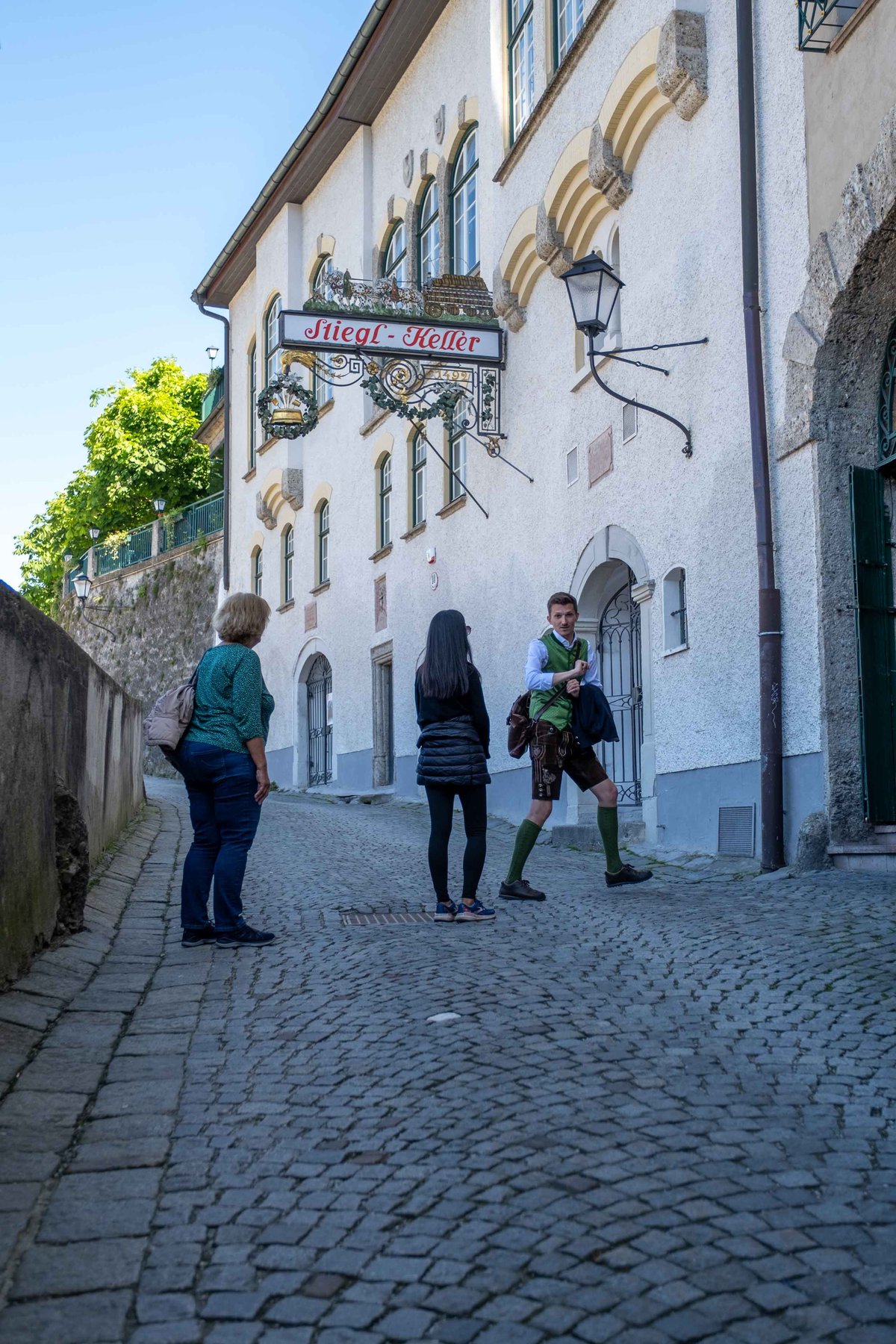
In Salzburg, it appears at Stiftskeller St Peter and Stieglkeller, and at alpine huts throughout the surrounding mountains. The version at a good alpine hut made to order after a morning walk is difficult to surpass. The only rule worth following: if you see it listed as ready immediately on a busy day, order something else instead and come back for it when the kitchen has time to make it properly.

Other Salzburg dishes
What Kaiserschmarrn actually is
A caramelised, torn pancake dusted with icing sugar and served with stewed plums. Substantial enough for a light main, delicate enough for dessert. On virtually every traditional menu in Salzburg from mountain huts to city restaurants.
The Story
Kaiserschmarrn starts as a pancake batter enriched with whipped egg whites for lightness. It goes into a buttered pan, cooks briefly until set on the edges but still soft in the centre, then gets torn into irregular pieces with two forks or spatulas and tossed until the torn edges caramelise in the butter and sugar. The result is a pile of soft, slightly crisp fragments, dusted with icing sugar and served with a small dish of Zwetschkenröster: stewed plums cooked down with sugar and a little lemon until they become a thick, sour-sweet compote.
The name translates as "Emperor's mess," and the story attached to it holds that the dish was created for Franz Joseph I, who dropped or mangled his pancake and was served the result as a happy accident. Whether or not this is accurate, the Habsburg association gave the dish its name and, eventually, its ubiquity: a dish suitable for an emperor became a fixture on every menu.
In Salzburg, it appears at Stiftskeller St Peter and Stieglkeller, and at alpine huts throughout the surrounding mountains. The version at a good alpine hut made to order after a morning walk is difficult to surpass. The only rule worth following: if you see it listed as ready immediately on a busy day, order something else instead and come back for it when the kitchen has time to make it properly.
Other Salzburg dishes

Editor's table
Where we send friends
Restaurants, cafes, and bars Gerhard returns to. Curated, not comprehensive.
Pantry
What grows in the region
“Save one evening for Salzburger Nockerl, and order it for two.”
It is the one Salzburg dish I have not shown you a photo of, because a photo cannot do it justice and the ones online are usually someone else’s. Three baked peaks of sweet soufflé dusted with sugar, meant to look like the snow on the city’s three hills. It collapses within minutes, so it is always made fresh and always shared. Get it at a proper restaurant, not a tourist trap, and watch it arrive still trembling. That is the meal people remember.
From the kitchen
Try a Salzburg classic
Snack
Bosna
A spiced bratwurst in a white roll, invented in 1949 by a Bulgarian immigrant, and now the closest thing Salzburg has to its own…
Drink
Glühwein
Mulled red wine with cinnamon, cloves, star anise, and orange peel, served steaming in a ceramic cup at the Christmas markets. The smell of…
Main Course
Gulasch
A deep, paprika-rich beef stew, the Austrian adaptation of the Hungarian original. Thick enough to coat a spoon, served with bread dumplings. On a…


