Snapshot
The Baroque composer who built the musical architecture that the Mozarts would later inhabit. Heinrich Ignaz Franz Biber arrived at the Salzburg court in 1670, rose to Hofkapellmeister in 1684, and was ennobled by Emperor Leopold I in 1690 as Biber von Bibern. He spent his entire career in Salzburg and died here in 1704. He is buried at Salzburg Cathedral.
His two signature works: the Mystery Sonatas, fifteen solo violin pieces of extraordinary technical ambition, each requiring a different scordatura tuning; and the Missa Salisburgensis, a 53-voice polychoral Mass written for the cathedral’s 1100-year jubilee in 1682. Both are considered among the most significant compositions of the Baroque.
The Story
Biber came from Bohemia and ended up in Salzburg through a combination of ambition and escape. He had been serving at the court of Prince-Bishop Karl von Liechtenstein-Kastelkorn in Kroměříž when he was sent to nearby Absam in 1670 to negotiate instrument purchases. He did not return. He travelled to Salzburg instead, presented himself at the court of Archbishop Max Gandolph von Khuenburg, and was hired.
The Archbishop did not pursue him. The friendship between Gandolph and the Bohemian bishop smoothed things over. Biber was formally released in 1676, by which point he had already been working in Salzburg for six years.
The court gave him scope. His rise was steady: valet and musician in 1670, Vizekapellmeister in 1679, Hofkapellmeister in 1684. In that last role he ran the court orchestra, directed the choir school, and managed the full budget for music at the court. He was also the finest violinist in the German-speaking world.
The Mystery Sonatas sit at the centre of his legacy. Fifteen pieces, each representing a station of the Rosary, each scored for solo violin and continuo, each requiring the violin to be retuned between movements. The technique is called scordatura: retuning the open strings to access chords and resonances unavailable in standard tuning. Biber used it to achieve effects that had never been heard before and that remained technically demanding for centuries after his death. The set is dedicated to Archbishop Gandolph. It was never published in his lifetime and survived in a single manuscript.
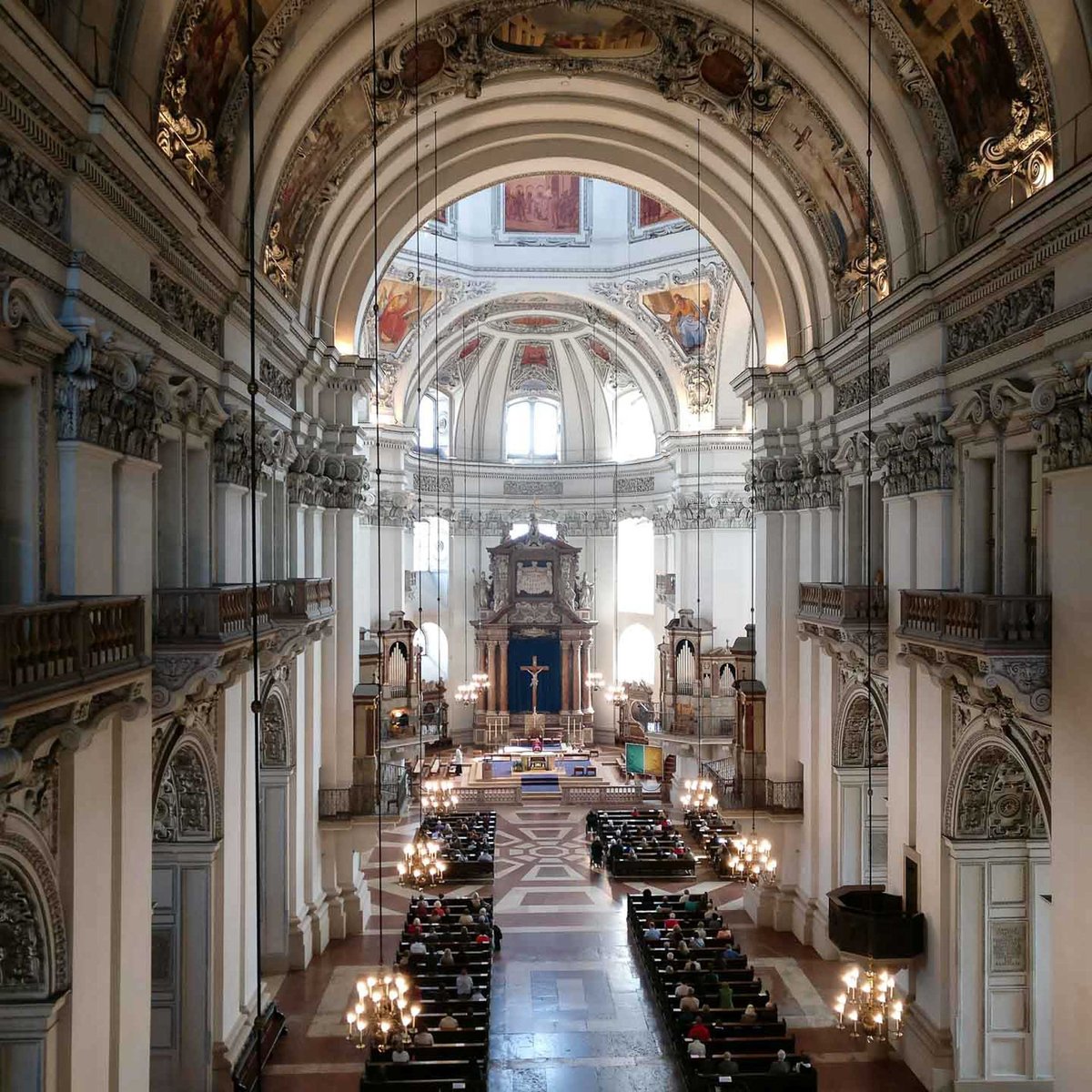
The Missa Salisburgensis is a different kind of achievement. Written for the 1100-year jubilee of Salzburg’s archbishopric in 1682, it calls for 53 voices split across multiple choirs placed in different parts of the cathedral, with brass, strings, and two organs filling the remaining space. The spatial effect was the point. The manuscript nearly disappeared, surfacing in the 1870s as a vegetable wrapper in a greengrocer’s storeroom before a scholar identified Biber’s hand.
Emperor Leopold I gave him a gold chain after a performance in 1677 and ennobled him in 1690. He became one of the very few musicians in the Habsburg world to receive a noble title. From that point on his manuscripts read Heinrich Ignaz Franz von Biber.
He died in 1704, 15 years before Leopold Mozart was born. The court he built, the cathedral ensemble he directed, and the musical standards he established were all still in place when Leopold arrived and his son grew up inside them.