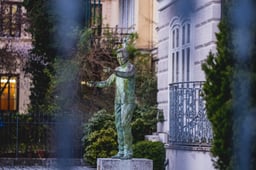
The conductor who made Salzburg the unquestioned summit of the musical world. Toscanini conducted at the Salzburg Festival from 1934 to 1937. He reportedly called Salzburg "the most perfect musical event in the world." When Austria was annexed by Nazi Germany in 1938, he refused to return.
The man who shaped the Mozarteum and the early Salzburg Festival more durably than almost anyone else. Director of the Mozarteum for over four decades (1917-1959), bridging the Festival's founding generation and the Karajan era.
A devoted disciple of Gustav Mahler and one of the foundational conductors of the Salzburg Festival. Walter gave the world premieres of Mahler's Das Lied von der Erde and the Ninth Symphony. Alongside Arturo Toscanini and Furtwangler, he formed the triumvirate that defined the young Festival's artistic identity. Forced to flee after the 1938 Anschluss.
Widely regarded by musicians as the greatest conductor of the latter 20th century. Carlos Kleiber conducted perhaps 96 concerts in his entire career, compared to hundreds per year for his contemporaries. What he did conduct he performed with an incandescence that left audiences stunned.
Artistic Director of the Salzburg Easter Festival from 2013, taking over from Seiji Ozawa. One of the foremost interpreters of Wagner, Brahms, and Richard Strauss of his generation. In the conducting lineage of Furtwangler and Bohm.
One of the supreme conductors of the late 20th century. Chief Conductor of the Vienna Philharmonic and then the Berlin Philharmonic, Abbado shaped the sound of the two most important orchestras in the German-speaking world and brought both repeatedly to the Salzburg Festival.
The man who built the Salzburg Festival from a promising young institution into the most prestigious music event in the world. Artistic Director 1926-1934, close friend of Richard Strauss, and co-librettist of Capriccio. Arturo Toscanini then crowned the foundations Krauss had laid.
One of the five co-founders of the Salzburg Festival (1920), alongside Hofmannsthal, Reinhardt, Strauss, and Roller. A pupil of Bruckner and long-serving director of the Vienna State Opera, Schalk brought institutional authority and conducting leadership to the fledgling Festival.
One of the supreme conductors of the 20th century. Solti's Ring Cycle recordings with the Vienna Philharmonic remain the standard against which all subsequent recordings are measured. A major presence at the Salzburg Festival.
Born in Salzburg, died near Salzburg. Widely regarded as one of the greatest conductors of the 20th century. Artistic director of the Salzburg Festival for much of the postwar period. The square in front of the Grosses Festspielhaus bears his name. His legacy dominates the classical music world to this day.
One of the greatest conductors of the 20th century, deeply associated with the Salzburg Festival across four decades. Richard Strauss himself chose Bohm to conduct premieres of Daphne and Die schweigsame Frau. He died in Salzburg, the city to which he returned again and again.
One of the most charismatic musicians of the 20th century. Bernstein's 24 December 1989 performance of Beethoven's 9th Symphony, with Freiheit (Freedom) substituted for Freude (Joy) to celebrate the fall of the Berlin Wall, is one of the most watched concerts in television history. The Salzburg Festival was a recurring stage throughout his career.
The conductor who changed how the world plays and hears baroque and classical music. Harnoncourt founded the Concentus Musicus Wien in 1953 and was a defining presence at the Salzburg Festival and Mozartwoche for decades. He died in St. Georgen im Attergau, a few kilometres from the Attersee.
One of the most important conductors of the late 20th and early 21st century. Muti has conducted at the Salzburg Festival across many decades, leading the Vienna Philharmonic in opera and concert programmes that have become part of the Festival's core identity. Known especially for Verdi, Mozart, and Cherubini.
One of the first Asian conductors to lead major Western orchestras, and a protege of Karajan whose Salzburg connection ran for decades: he made his Salzburg Festival debut in 1966 and returned for some four dozen performances. From 2002 to 2010 he was Music Director of the Vienna State Opera.
One of the supreme conductors of the 20th century, and perhaps the most controversial. Furtwangler's decision to remain in Germany during the Nazi period made him a figure of perpetual moral debate. His post-war Salzburg Festival performances in the early 1950s are among the most legendary in recording history.
The conductor who brought classical music to genuinely global audiences. Music Director of the Israel Philharmonic for over fifty years and one of the Vienna Philharmonic's most beloved conductors. Conducted the legendary Three Tenors concert in Rome (1990), watched by an estimated 800 million people.