Czech-German sculptor (1940 to 2021), best known for the Cloak of Conscience: a monumental bronze of an empty, hooded mantle with no body or head inside, where the absence itself is the subject. Casts of it stand in cities across Europe.
The sculptor behind the horse-taming group at the Pferdeschwemme (Horse Pond), completed 1695 under Johann Ernst von Thun. A powerful figure wrestling a rearing horse above the central basin, transforming a functional horse-watering facility into one of the most theatrical baroque set pieces in Salzburg.
The supreme sculptor of the Austrian Baroque. Donner's lead allegorical figures adorn the fountain basin in Mirabell Gardens, among the most graceful sculptural accents in any European baroque garden.
Austrian sculptor whose Berliner Block (2017), a massive rectangular stone block in the Mirabell Gardens, confronts the ordered baroque symmetry of one of the city's most beloved gardens with an elemental, unworked form.
Swiss-born sculptor who came to Salzburg during Wolf Dietrich's transformative building programme. Part of the first wave of Italian-Swiss craftsmen who replaced Salzburg's Gothic visual character with the early baroque.
Catalan sculptor whose Awilda (2010), a five-metre white bust of a young woman with closed eyes, stands in the courtyard of the University of Salzburg's law faculty on Kapitelgasse. Named after a legendary Scandinavian pirate queen.
Sculptor and son of Lorenz Hagenauer, the Mozart family's landlord and Leopold's closest friend. He grew up in the same house as the young Mozart family (Getreidegasse 9) and created works that are still seen in Nonnberg Abbey and Salzburg Cathedral.
The master sculptor of the Salzburg Salzkammergut. Guggenbichler spent his entire working life creating altars and sculptures for the churches of the Mondsee and St. Gilgen area. His baroque sculptures stand in the background of the Mondsee church's wedding scene in The Sound of Music, seen by millions who have no idea who carved them.
The Bavarian sculptor who created the bronze Mozart statue at the centre of Mozartplatz. Unveiled in 1842, 51 years after Mozart's death, in the presence of Mozart's two surviving sons. One of the first major public statues erected in honour of a composer anywhere in the world.
Austrian sculptor whose Connection (2011), an eleven-metre steel wave at Rudolfskai, creates a dialogue between the medieval city wall and a contemporary organic form. Visitors can step inside the curving steel structure.
The Venetian sculptor behind the mythological statue groups of the Mirabell Gardens Grand Parterre and, with Bernhard Michael Mandl, the marble dwarves of the Zwerglgarten, both carved around 1690 under the Salzburg prince-archbishops.
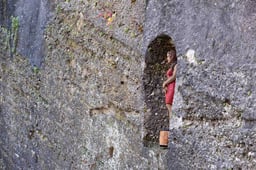
German sculptor who created two permanent Walk of Modern Art works in Salzburg: Sphaera on Kapitelplatz (a man standing on a golden sphere) and Frau im Fels in the Toscaninihof (a woman half-emerging from stone).
The sculptor behind the Residenzbrunnen, the magnificent baroque fountain at the centre of Residenzplatz, completed around 1661. One of the largest and finest baroque fountains in Central Europe, seen by every visitor arriving at the Cathedral square.
British sculptor who created Caldera (2008) on Makartplatz, a large enterable bronze sculpture whose swirling, cave-like interior invites visitors to step inside. Turner Prize winner (1988).