Story
Fischer von Erlach in Salzburg: The Architect Behind the Skyline
Published March 25, 2026 · Updated July 25, 2026
If you have seen Schonbrunn Palace in Vienna, the most visited building in Austria, you have seen the work of Johann Bernhard Fischer von Erlach. He designed it. He also designed the Karlskirche, the National Library, and much of imperial Vienna’s monumental face.
Before all of that, he was in Salzburg. And the two churches he built here, the Kollegienkirche and the Dreifaltigkeitskirche, are arguably his finest work. Salzburg was the proving ground. Vienna was the career. But the proving ground produced the masterpieces.
Who He Was
Fischer von Erlach trained in Rome, studying under Bernini’s circle. He absorbed the Italian baroque tradition at its source and returned to the German-speaking world with a style that combined Italian drama with a clarity and restraint that was distinctly his own.
Archbishop Johann Ernst von Thun hired him. The two men shared an ambition: to give Salzburg churches that could stand alongside anything in Rome. The archbishop provided the money and the sites. Fischer von Erlach provided the designs.
He built four churches in Salzburg. The Kollegienkirche and the Dreifaltigkeitskirche are the two that define his legacy. The Johannesspitalkirche and the pilgrimage church at Maria Kirchental complete the set.
Kollegienkirche: The Revolution in White
The Kollegienkirche stands on Universitaetsplatz, behind the daily market, a few steps from Getreidegasse. Most tourists walk past it on their way to Mozart’s Birthplace. That is a mistake I point out on every tour.
This is my favorite church in Salzburg. It is unlike any church you have seen before. There are no paintings on the walls. No heavy gilding. No carved saints staring down at you. The interior is almost entirely white: white walls, white vaults, white light pouring through clear windows. The effect is not cold. It is spacious, calm, and overwhelming in a way that decoration cannot achieve.
The facade bulges outward, a convex surface that swells toward the square. This was deliberate. Fischer von Erlach designed the Kollegienkirche with a convex facade and the Dreifaltigkeitskirche across the river with a concave one. The two churches are in dialogue across the city. One pushes outward. The other pulls you in.
When you visit, do what the space asks you to do. Lie down on one of the sloping wooden benches, look up at the vault, and be aware of the scale of the room. This is what Fischer von Erlach designed for: the experience of space itself, not the decoration within it.
Dreifaltigkeitskirche: The Dome Across the River
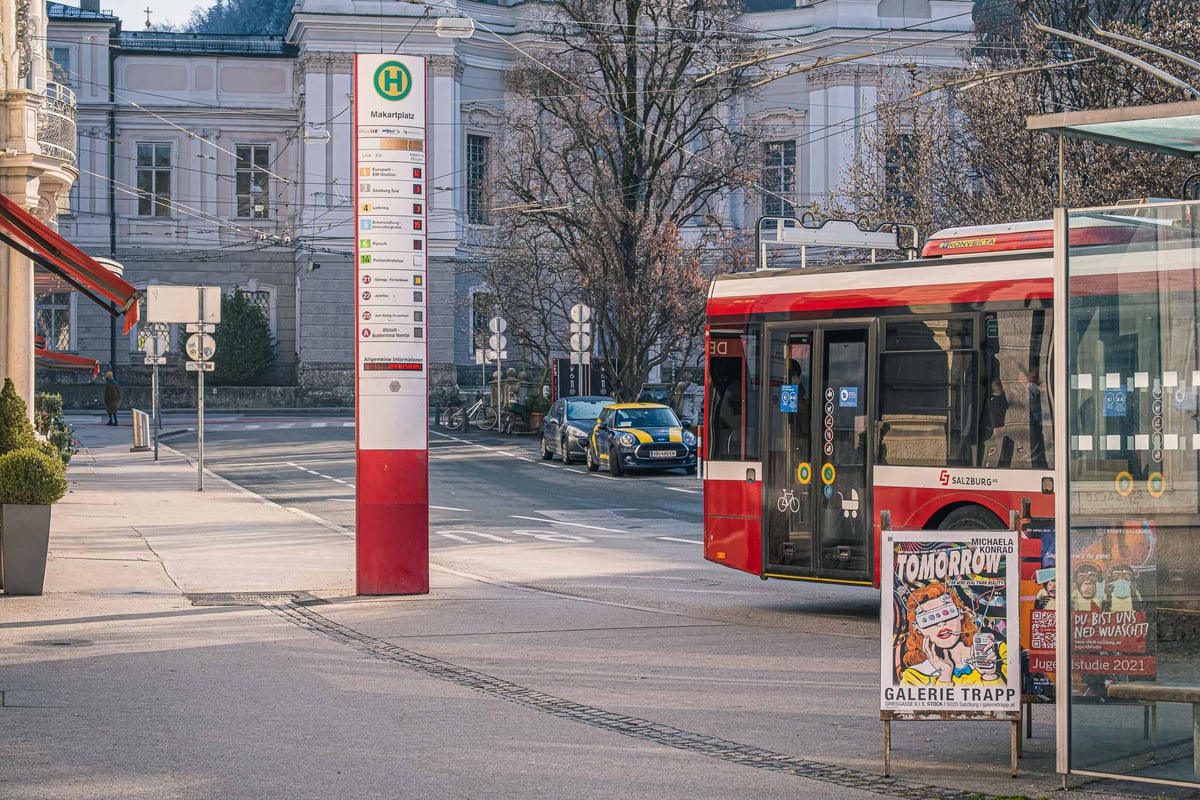
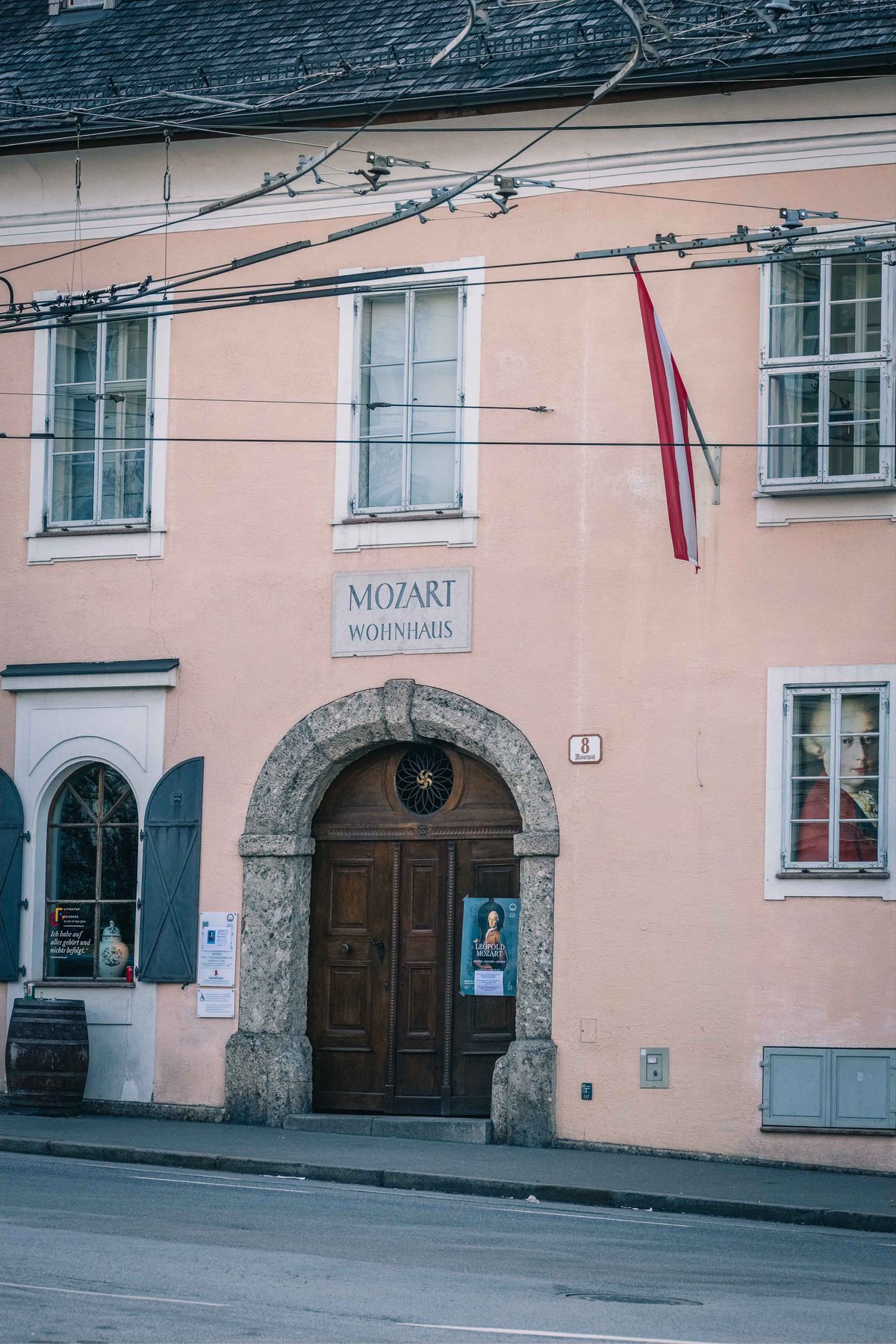
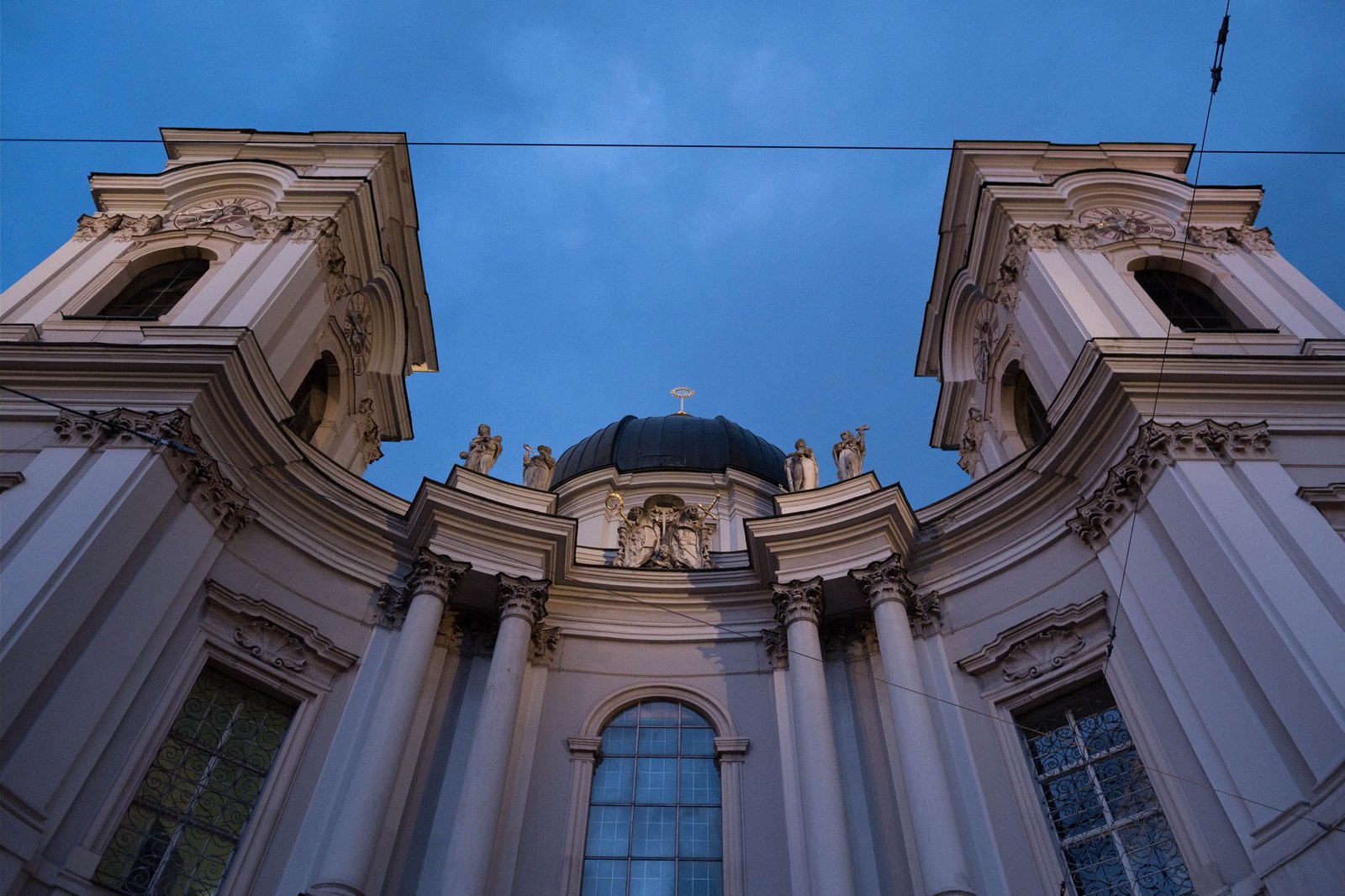
The Trinity Church stands on Makartplatz, on the right bank, adjacent to Mozart’s Residence. Where the Kollegienkirche bulges outward, this one curves inward: a concave facade flanked by paired towers.
The interior is smaller but concentrated around the dome, which carries ceiling frescoes by Johann Michael Rottmayr. Fischer von Erlach and Rottmayr worked together repeatedly. The dome at Dreifaltigkeitskirche is their most intimate collaboration in Salzburg.
The church is free to enter and rarely crowded. It takes five minutes. Those five minutes show you what Fischer von Erlach could do with a small space and a dome. The Kollegienkirche shows what he could do with a large space and light.
Two Churches, One Conversation
The concave-convex pairing is not accidental. Fischer von Erlach placed one on each bank of the Salzach, facing each other across the city. The Kollegienkirche on the left bank, embedded in the old town. The Dreifaltigkeitskirche on the right bank, marking the newer district.
Together they frame the city. Stand on the Makartsteg and you are between them. That position, between two Fischer von Erlach churches, between old town and new town, between convex and concave, is as close to understanding Salzburg’s architectural logic as you can get without reading a textbook.
His style is so distinct that even churches not formally attributed to him are suspected to be his. St. Marcus Church on the Monchsberg and the Johannesspitalkirche in the Mulln district carry his fingerprints. As one source puts it: “Fischer’s style is so distinct that there is no doubt.”
From Salzburg to Vienna
After his Salzburg commissions, Fischer von Erlach moved to Vienna and became the defining architect of the Habsburg Empire. Schonbrunn Palace. The Karlskirche. The Hofbibliothek. The buildings that tourists photograph in Vienna exist because an archbishop in Salzburg took a chance on a young architect who had trained in Rome.
The imperial buildings are grander. The Salzburg churches are purer. In Vienna, Fischer von Erlach had to serve an empire’s vanity. In Salzburg, he served an idea about what a church could be: a space defined by light, proportion, and the absence of distraction.
What to Visit
| Church | Location | What to Notice | Time Needed |
|---|---|---|---|
| Kollegienkirche | Universitaetsplatz (old town) | Convex facade, white interior, sloping benches, light | 15 minutes |
| Dreifaltigkeitskirche | Makartplatz (right bank) | Concave facade, Rottmayr dome frescoes, intimacy | 5 minutes |
Both are free. Both are usually quiet. Most visitors see neither. That is their loss and your advantage.