Story
What Is Baroque? Salzburg and the Art Movement That Shaped a City
Published March 25, 2026 · Updated July 5, 2026
Every visitor to Salzburg walks through baroque architecture without knowing what that word actually means. The guides say “baroque” and point at a church. The audio guide says “baroque facade” and moves on. Nobody explains why every building looks the way it does, or why it looks so different from what came before, or why Salzburg of all places became the first city north of the Alps to adopt it.
The short version: baroque was the Catholic Church’s answer to the Protestant Reformation. Rome invented it. Salzburg imported it. And the city you see today is the physical result of a religious war fought with marble, gold leaf, and light.
The Back and Forth: How Art Movements Work
Art movements do not appear from nowhere. Each one is a reaction to the one before. Understanding baroque means understanding the chain.
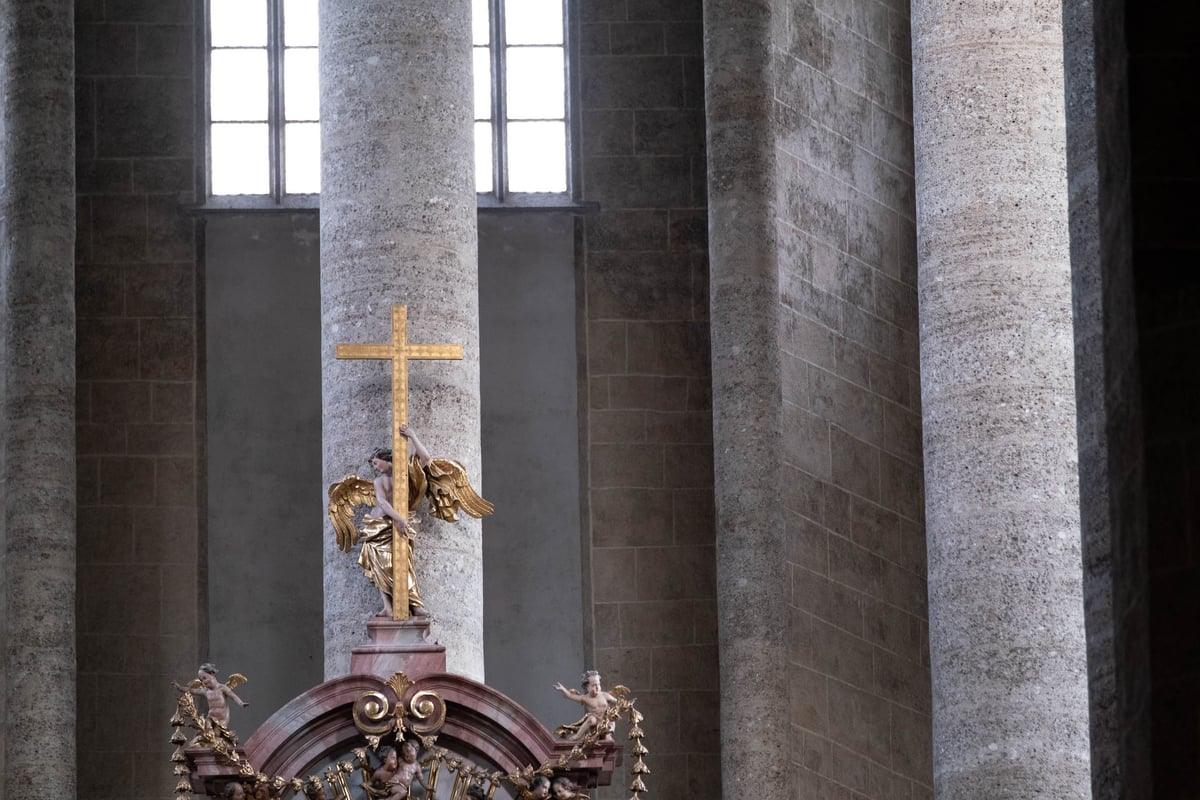
Romanesque (roughly 800-1200): heavy walls, small windows, round arches. Churches were dark, solid, fortress-like. In Salzburg, the nave of the Franziskanerkirche preserves this: walk in and the first half of the church is 13th-century stone, dim and heavy. One of the oldest structures in the city.
Gothic (roughly 1200-1500): the counter-movement. Pointed arches replaced round ones. Walls got thinner. Windows got enormous. Light poured in. The choir of the same Franziskanerkirche is Gothic: suddenly the ceiling soars, the stone gets lighter, and the space opens up. In one building you can see two centuries of architectural argument.
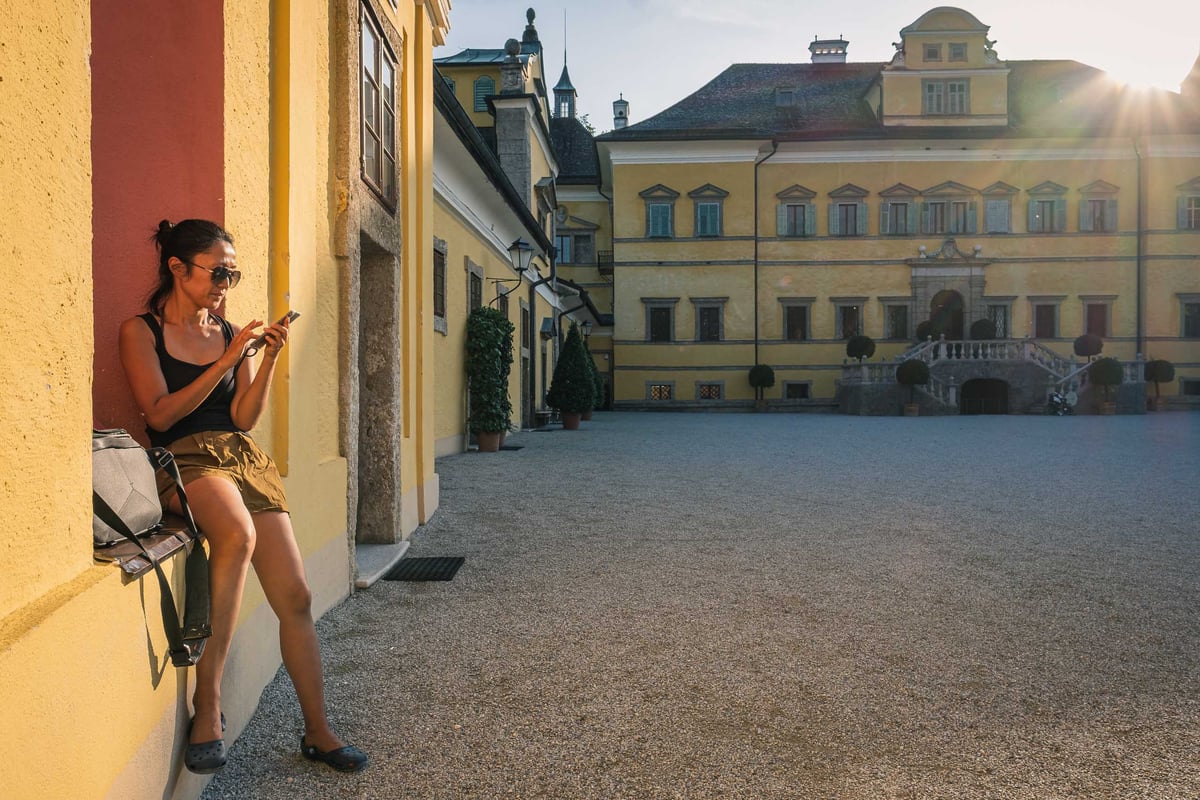
Renaissance (roughly 1400-1600): the counter-counter-movement. Rediscovery of classical Greek and Roman forms. Symmetry, proportion, human scale. Calm after the Gothic vertical ambition. Italy led. The rest of Europe followed slowly. Hellbrunn Palace has strong Renaissance elements: symmetrical, measured, grounded. Marcus Sitticus built it with Italian architects who brought Renaissance principles north.
Baroque (roughly 1600-1750): the reaction to the Reformation. And this is where Salzburg enters the story.
Why Baroque Happened
In 1517, Martin Luther published his theses and split Christianity in half. The Protestant Reformation swept northern Europe. Churches were stripped bare. Statues removed. Walls whitewashed. The message was: faith needs no decoration. God does not live in gold.
The Catholic Church’s response was the Counter-Reformation. The Council of Trent (1545-1563) laid out the program: art should serve faith. Churches should overwhelm the senses. Architecture should make the power of God physically felt. Painting, sculpture, music, space, and light should work together to create an emotional experience that no sermon alone could deliver.
That program became baroque. It started in Rome. The Jesuits built the first baroque churches. Bernini sculpted it. Borromini designed it. Within a generation, every Catholic power in Europe wanted the same.
How Salzburg Got It First
Salzburg’s prince-archbishops were Catholic rulers of an independent state. They reported to the Pope, not to the Emperor. They had Italian connections, Italian architects, and Italian ambitions. And they had salt money to pay for all of it.
Wolf Dietrich von Raitenau had been to Rome. He came back in the 1580s with a plan to rebuild Salzburg as a northern Rome. He demolished the old Romanesque cathedral. He cleared medieval houses to make space for grand squares. He hired Italian builders.
His successor Marcus Sitticus commissioned Santino Solari, an Italian architect, to design a new cathedral. It was consecrated in 1628 under Paris Lodron. That date matters. It was the first major baroque cathedral built north of the Alps. Before Munich, before Vienna, before Prague. Salzburg was first because its archbishops had the money, the power, and the direct line to Rome.
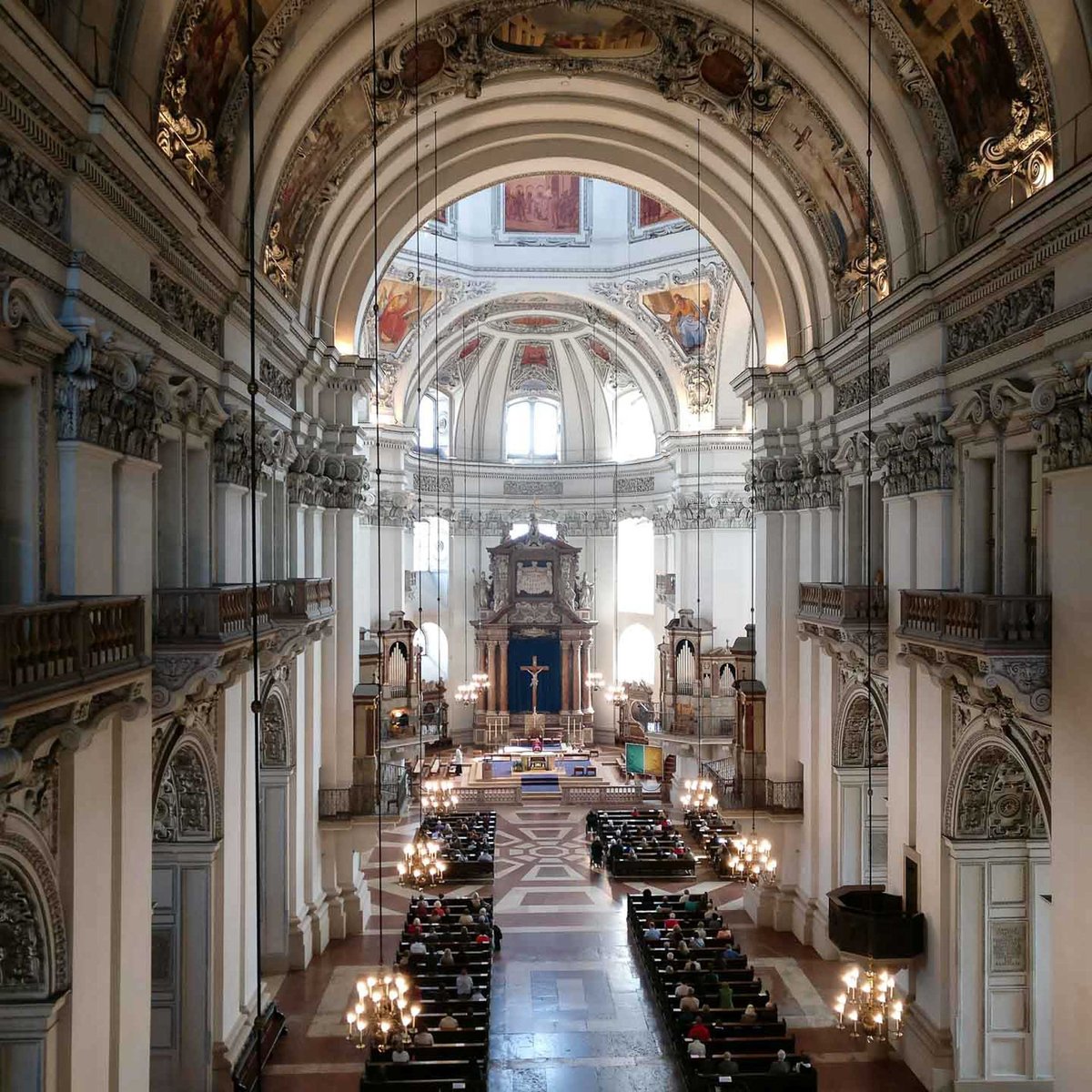
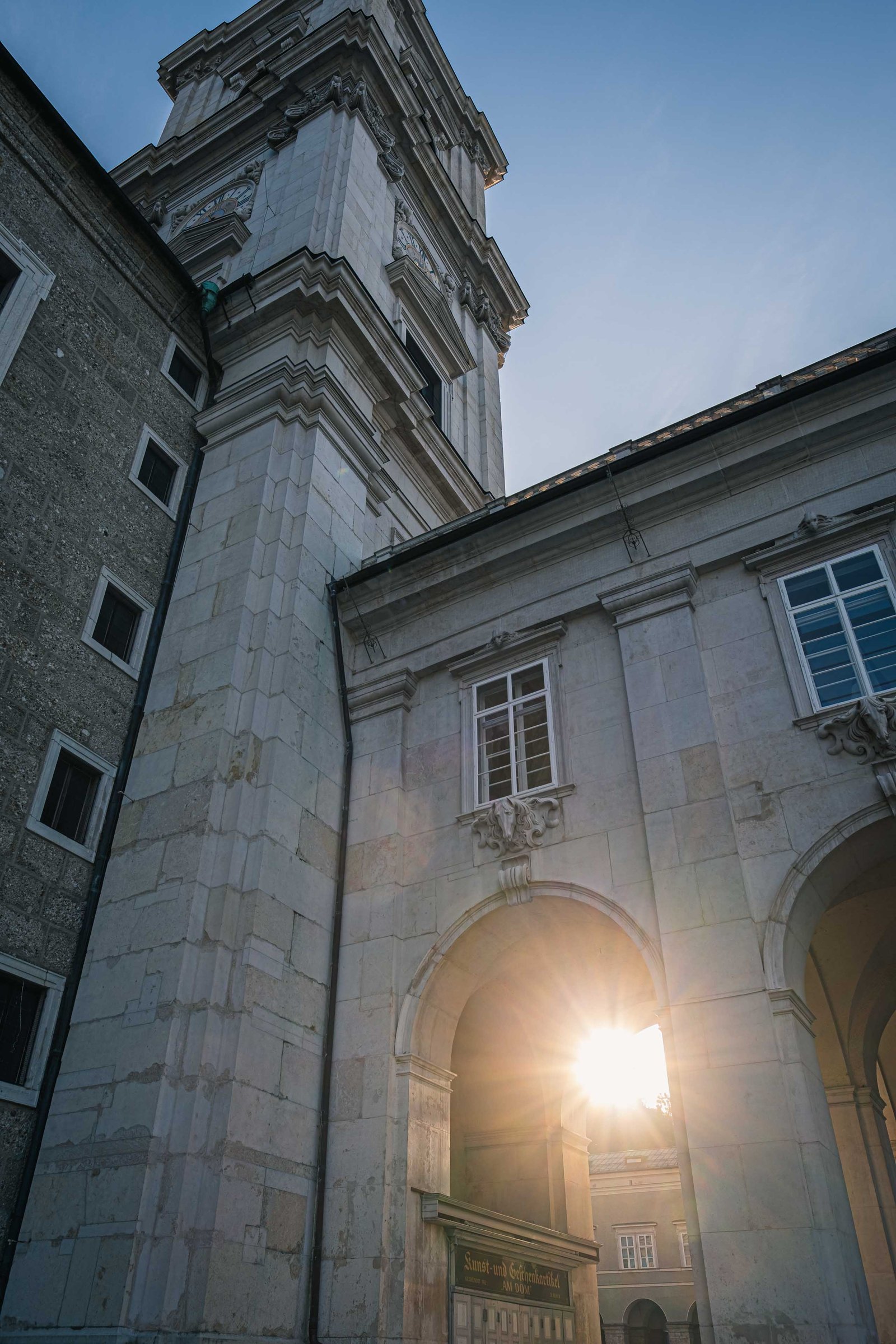
The Cathedral set the template. Twin towers. Marble facade from Untersberg. A dome. An interior designed to make the visitor feel small before God and large in the presence of beauty. Every baroque church built in the German-speaking world after 1628 existed in the shadow of what Solari built in Salzburg.
What Baroque Actually Looks Like
Baroque is not just “ornate.” It is a specific set of ideas made physical:
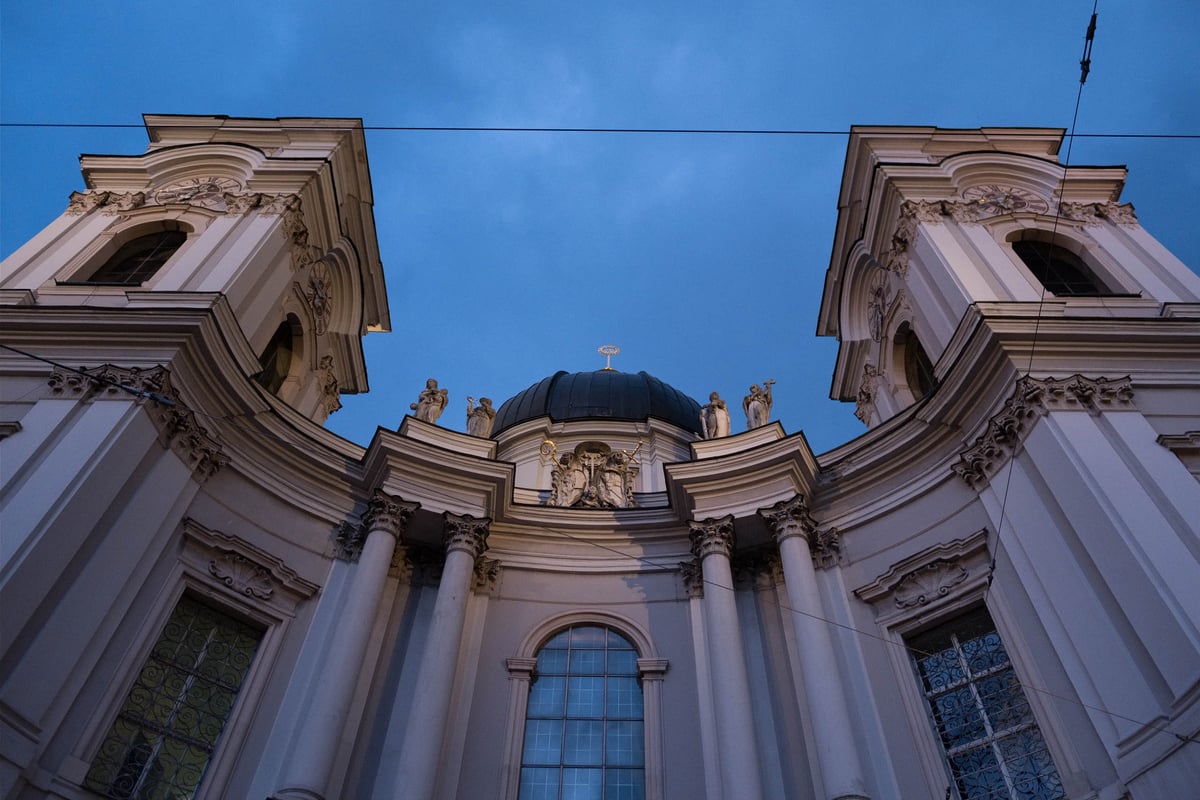
Movement. Straight lines become curves. Facades push outward (convex) or pull inward (concave). Columns twist. Ceilings are painted to look like they open to the sky. Nothing sits still. The Kollegienkirche has a convex facade that pushes outward. The Dreifaltigkeitskirche across the river draws you in. Fischer von Erlach designed both as a conversation across the city.
Light. Baroque architects used windows as instruments. They controlled where light entered, how it fell, what it illuminated. The Kollegienkirche interior is almost entirely white. The light does the decorating. The Cathedral uses the dome to funnel light downward onto the nave.
Emotion. Gothic architecture pointed upward to God. Renaissance architecture measured human proportion. Baroque architecture attacked the senses. Ceiling frescoes by painters like Johann Michael Rottmayr were designed to make you look up and feel transported. The boundary between the painting and the architecture blurs. You cannot tell where the wall ends and heaven begins. That is the point.
Scale. Baroque buildings are larger than they need to be. The Residenz state rooms are palatial for a city of 16,000 people. The Cathedral seats a congregation far larger than the population justified. The scale was not for the people. It was for the message: this is the power of the Church, and you are standing inside it.
After Baroque
The chain continued.
Rococo (roughly 1730-1780): baroque’s playful younger sibling. Lighter, more decorative, less about power and more about pleasure. Pastels replaced deep colors. Shells and scrollwork replaced heavy columns. In Salzburg, the interior of Stift St. Peter shows the transition: Romanesque bones underneath, Rococo decoration on top. Layer after layer, century after century.
Classicism (roughly 1750-1830): the counter-movement. Europe grew tired of decoration. Back to Greek and Roman purity. Straight lines. White columns. Restraint. This is the era that produced Mozart’s music but stripped away the visual excess he grew up with. In Salzburg, Colloredo was an Enlightenment archbishop who found baroque excess distasteful. His reforms ended the building frenzy. Salzburg’s baroque core was essentially frozen in place by the time classicism arrived, which is why it survived so intact.
And then it starts again. Romanticism reacted against classicism’s coldness. Neo-Gothic revived medieval forms. Art Nouveau broke every rule. Modernism stripped everything bare. The Museum der Moderne sits on the Monchsberg cliff above a baroque old town, its clean concrete facade an argument with the buildings below. The Walk of Modern Art places contemporary sculpture in baroque squares. The conversation never stops.
What You See When You Walk Through Salzburg
Once you understand the chain, the city reads differently.
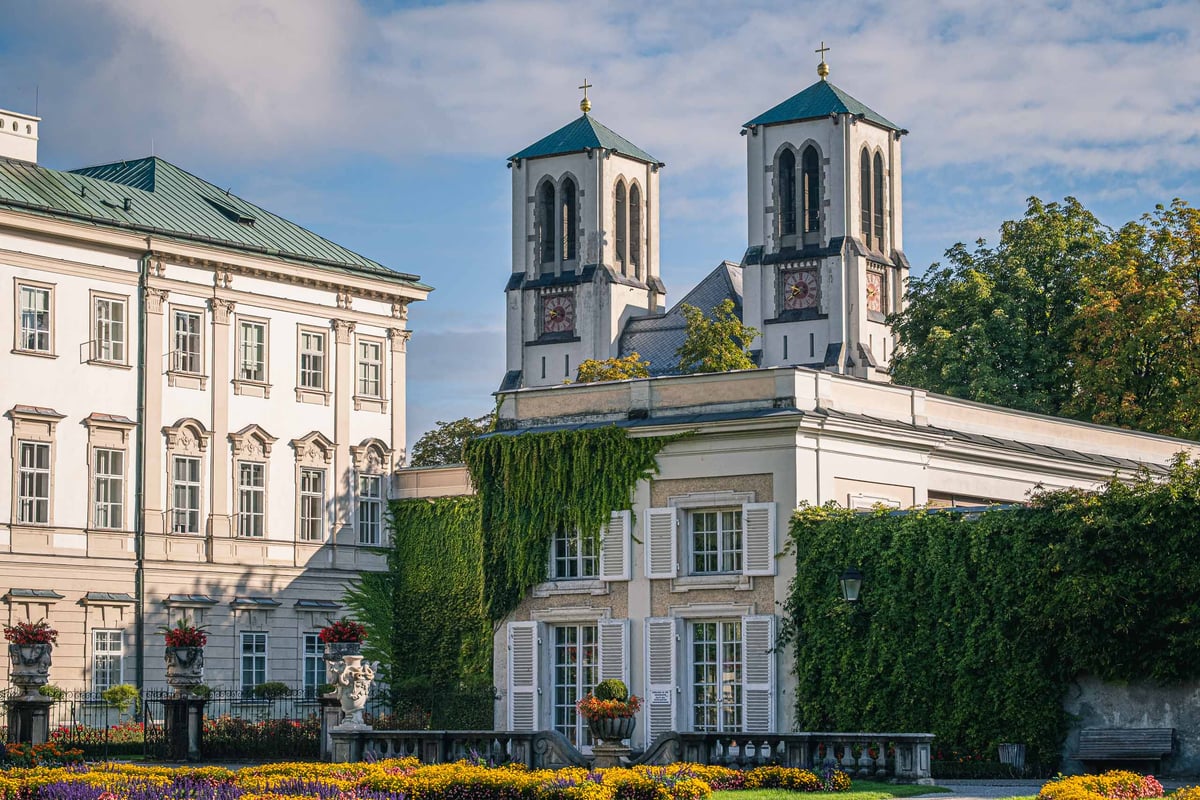
The Franziskanerkirche is Romanesque and Gothic in one building. The Cathedral is the moment baroque arrived north of the Alps. The Kollegienkirche is baroque at its purest: light and space, no decoration. Stift St. Peter is every era stacked on top of every other era. The Residenz is power turned into rooms. Mirabell Palace is a love story turned into a building.
None of this is random. None of it is just “old European architecture.” Every facade is an argument. Every dome is a statement. And every statement was funded by salt from a mine fifteen minutes south of the city.
Salzburg is small. You can see all of this in an afternoon. But knowing what you are looking at changes an afternoon of walking into a thousand years of ideas made visible.