Story
What Most Mozart Guides Get Wrong
Published March 25, 2026 · Updated July 25, 2026
Every week on my tours, someone asks about Salieri. Every week I explain that Amadeus is a film, not a documentary. That is only the beginning. The popular version of Mozart’s life is a mix of half-truths, romantic exaggeration, and Hollywood invention. Here are the things most guides repeat that do not hold up.
Myth 1: Mozart Died Poor
He did not. Mozart earned well in Vienna. He charged premium rates for lessons, received commissions, and had a court appointment as Imperial Chamber Composer. His income in his best years was substantial by the standards of 18th-century musicians.
The problem was spending, not earning. Mozart and Constanze lived beyond their means. They moved apartments frequently, always to something bigger. He had a taste for fine clothes and billiards. The final year was financially difficult, with fewer commissions and mounting debts. But “difficult” is not “destitute.” He was not starving in a garret. He was a freelance professional in a bad year.
The poverty myth comes from 19th-century biographers who needed a tragic arc. The reality is more ordinary and more human: a talented man who was bad with money.
There is a theory that this ran in the family. Mozart’s grandfather built a house in St. Gilgen and the construction plunged him into debt. When he died unexpectedly, he left his wife and his four-year-old daughter, Mozart’s mother, in poverty.
Myth 2: Salieri Poisoned Him
He did not. This story was invented by Alexander Pushkin in a short play in 1830 and cemented by Peter Shaffer’s Amadeus in 1979. The film turned it into global common knowledge. It is fiction.
Antonio Salieri was Imperial Kapellmeister in Vienna for 36 years. He was more successful and more respected than Mozart during their lifetimes. He had no reason to poison a younger colleague who was, at the time, less established at court. Salieri taught Beethoven, Schubert, and Liszt. He was a generous and respected figure.
Mozart himself spread an early version of the rumor. Near the end of his life, he told Constanze he believed he was being poisoned. He did not name Salieri. The cause of his death is still debated among medical historians. Rheumatic fever, kidney disease, and several other conditions have been proposed. Poison is not among the credible theories.
Myth 3: He Never Revised His Work
The image of Mozart writing perfect music in a single draft, ink flowing without hesitation, is one of the most persistent myths. It comes partly from the film, partly from early biographers who wanted to emphasize his genius.
His manuscripts tell a different story. They contain crossings-out, rewritten passages, and abandoned drafts. He revised. He reworked. He sometimes set a piece aside for months before returning to it. The Requiem was unfinished at his death, with sections at various stages of completion.
Mozart was extraordinarily fast and extraordinarily productive. That is documented and genuine. But fast is not the same as effortless.
Myth 4: The Shameful Burial
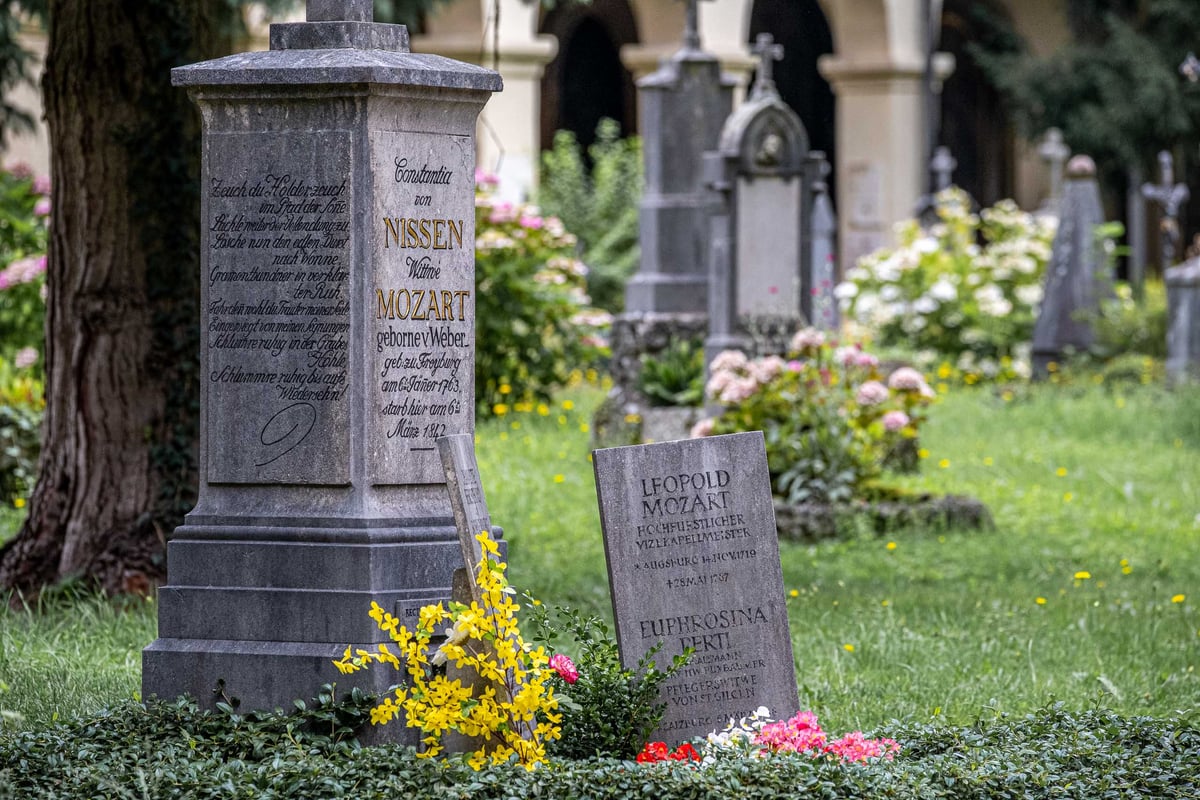
Mozart was buried in a common grave at St. Marx Cemetery in Vienna. The popular version treats this as a scandal: proof that his genius went unrecognized, that he was thrown away like a pauper.
The reality is administrative, not tragic. Emperor Joseph II had reformed Viennese burial practices in the 1780s. Individual grave markers were discouraged. Communal burial plots were standard practice for the middle class. Mozart’s burial followed the norm for someone of his social standing. It was not a statement about his value. It was the law.
What is genuinely strange is that no one recorded where exactly he was buried. The grave was not marked at the time, and when interest in Mozart grew decades later, the location could not be recovered. We still do not know where he is.
A skull in the Stiftung Mozarteum collection was long claimed to be his. DNA testing showed it does not match the remains in the family grave at Sebastiansfriedhof. More unsettling: the DNA also showed that the people buried in the family grave are not related to each other either.
Myth 5: He Was a Carefree Genius
The film gives us a giggling, irreverent Mozart who composed between pranks. The real Mozart was driven, disciplined, and often anxious.
Leopold Mozart trained him from the age of three. The European tours that began at six were not adventures. They were grueling work schedules on horse-drawn carriages, lasting months, crossing borders, performing in cold concert halls for aristocrats who might or might not pay. Mozart’s mother died in Paris during one of these trips. He was twenty-two, alone, and writing to his father in stages because he could not say it directly.
Mozart was funny in his letters. He was irreverent. He had a genuine gift for scatological humor that embarrassed his 19th-century editors. But underneath that was a man who worked constantly, worried about money, fought with his employer, broke with his father, and died at thirty-five with an unfinished Requiem on his desk.
Carefree is the last word that fits.
What the Real Mozart Was Like
Ambitious. Restless. Proud. Convinced of his own talent and angry that the world did not always recognize it. A son who loved his father but chose independence over obedience. A husband in a marriage that started with scandal and survived on mutual loyalty. A composer who produced over 600 works in a career that lasted about 25 years, and who was still getting better when he died.
He hated Salzburg. He said so in almost every letter. He called it provincial, unstimulating, suffocating. “There isn’t a penny’s worth of stimulation in this town,” he wrote. “It’s as if the audience consisted of nothing but tables and chairs.”
The city put his name on the airport, the square, the bridge, the chocolate, the university, and the opera house. He would probably have found that hilarious. Or infuriating. Possibly both.
Why the Myths Persist
Because they are better stories. A poisoned genius is more dramatic than a freelance composer who caught a fever. A pauper’s burial is more tragic than a standard middle-class funeral. An effortless prodigy is more inspiring than a disciplined professional who worked hard and revised his drafts.
The real Mozart is more interesting than the myth. But he is harder to sell on a chocolate wrapper.